
Vocabulary and Properties of 3-D Shapes
Three dimensional shapes have length, width and height. They are described using specific vocabulary related to their faces, edges and vertices. Understanding these terms helps you recognise shapes and describe their properties accurately.
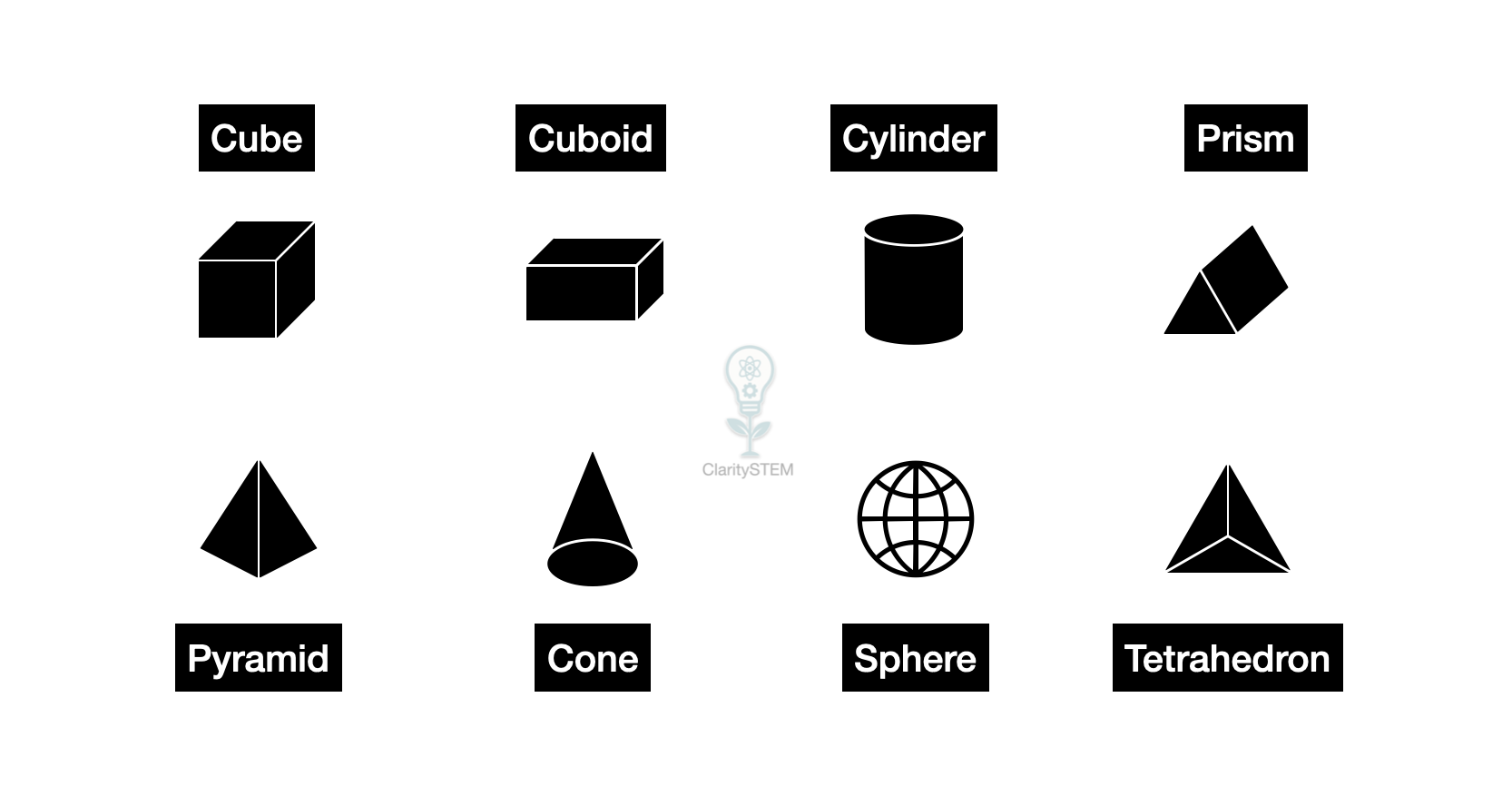
Cube
A cube is a three dimensional shape with:
• six square faces
• all edges equal in length
• eight vertices
• three edges meeting at each vertex
All faces are congruent and all angles are right angles.
Cuboid
A cuboid is similar to a cube but does not have all edges equal.
A cuboid has:
• six rectangular faces
• opposite faces equal and parallel
• twelve edges
• eight vertices
A cube is a special type of cuboid.
Cylinder
A cylinder has both flat and curved surfaces.
A cylinder has:
• two circular flat faces
• one curved surface
• no vertices
• two curved edges
The flat faces are parallel and congruent.
Prism
A prism is a solid with a constant cross section.
A prism has:
• two identical parallel faces called ends
• rectangular faces joining the ends
• the same cross section throughout
Prisms are named after the shape of their ends, such as triangular prisms or pentagonal prisms.
Pyramid
A pyramid has a polygon base and triangular faces that meet at a single point.
A pyramid has:
• one base
• triangular faces
• one vertex at the top called the apex
Pyramids are named after the shape of their base, such as square based or triangular based pyramids.
Cone
A cone has a circular base and a curved surface that meets at a point.
A cone has:
• one circular flat face
• one curved surface
• one vertex at the top
The pointed end is called the apex.
Sphere
A sphere is a perfectly round three dimensional shape.
A sphere has:
• one curved surface
• no flat faces
• no edges
• no vertices
Every point on the surface is the same distance from the centre.
Tetrahedron
A tetrahedron is a type of pyramid with a triangular base.
A tetrahedron has:
• four triangular faces
• six edges
• four vertices
All faces may be congruent in a regular tetrahedron.
Key Points to Remember
Three dimensional shapes have faces, edges and vertices.
Some shapes have curved surfaces as well as flat faces.
Prisms and pyramids are named after the shape of their base.
A cube is a special type of cuboid.
Spheres have no edges or vertices.
Understanding the vocabulary and properties of 3-D shapes allows you to identify, compare and describe solid shapes clearly and accurately.