
Solving Problems Involving Intersecting Loci
This topic focuses on solving problems where two or more loci are drawn on the same diagram. The solution is found by identifying points or regions that satisfy all given conditions at the same time.
What Intersecting Loci Mean
A locus shows all possible positions of a point that follows a specific rule.
When more than one condition is given, each condition produces its own locus.
The required solution is found where these loci intersect or overlap.
Only points that satisfy every condition are included in the solution
Identifying the Required Loci
Each condition in the problem must be interpreted carefully.
Examples include:
• a fixed distance from a point
• equidistant from two points
• a fixed distance from a line
• on one side of a boundary
Each condition is drawn accurately using a ruler, protractor or compasses.
The order does not matter, but all loci must be drawn on the same diagram.
Finding Points of Intersection
When two loci cross, the points of intersection represent solutions that satisfy both conditions.
For example:
• a circle intersecting a perpendicular bisector
• two circles intersecting
• an angle bisector intersecting a circle
If the question asks for exact positions, the intersection points are the answers.
If the loci do not intersect, there may be no solution.
Identifying Regions That Satisfy Conditions
Some problems ask for a region rather than exact points.
In these cases, the solution is the area that lies:
• inside one locus
• outside another locus
• on a specific side of a line
The required region is often shaded.
Boundaries may be:
• solid, meaning points on the boundary are included
• dashed, meaning boundary points are not included
Reading the wording carefully determines which regions are allowed
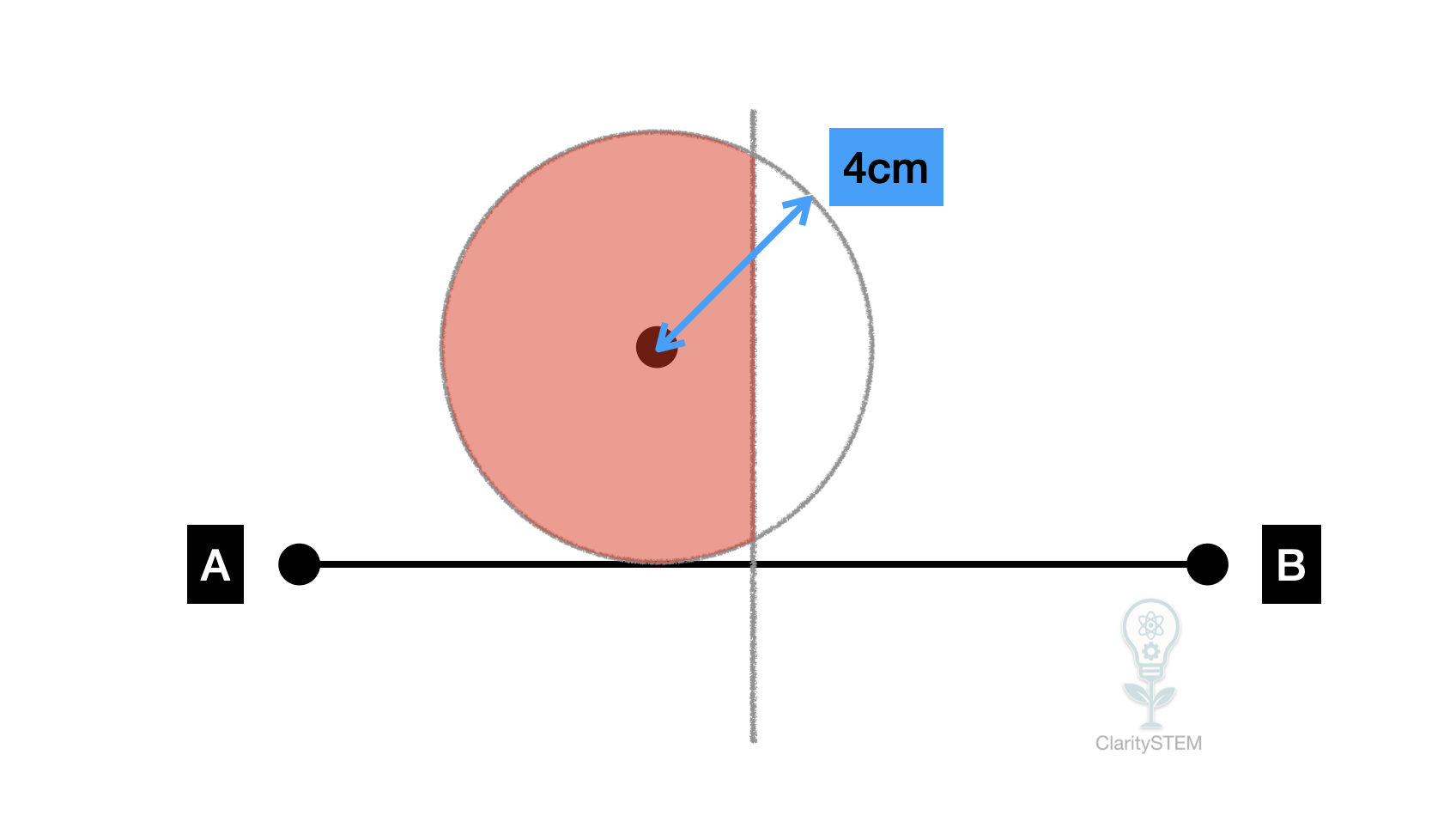
Worked Interpretation Example
A point must be:
• within 4 cm of a fixed point
• closer to point A than point B
The first condition produces a circle.
The second condition produces a perpendicular bisector, with the valid region on one side.
The solution is the part of the circle on the correct side of the bisector.
Interpreting the Diagram
Once the diagram is complete, interpretation is essential.
Check that:
• all constructions are accurate
• regions match the conditions
• no extra areas are included
The final answer may be:
• a point
• several points
• a shaded region
Key Points to Remember
Each condition produces its own locus.
Solutions must satisfy all conditions simultaneously.
Intersection points solve point based problems.
Overlapping areas solve region based problems.
Clear diagrams are essential for correct answers.
Solving intersecting loci problems relies on accurate construction and careful interpretation of which points or regions meet every given condition.