
Identifying Equations of Parallel and Perpendicular Lines
⭐ Higher Tier Content
Understanding Gradients
The gradient of a straight line tells you how steep the line is.
In the equation \( y = mx + c \), the gradient is \( m \).
The gradient is the key feature used to identify whether lines are parallel or perpendicular.
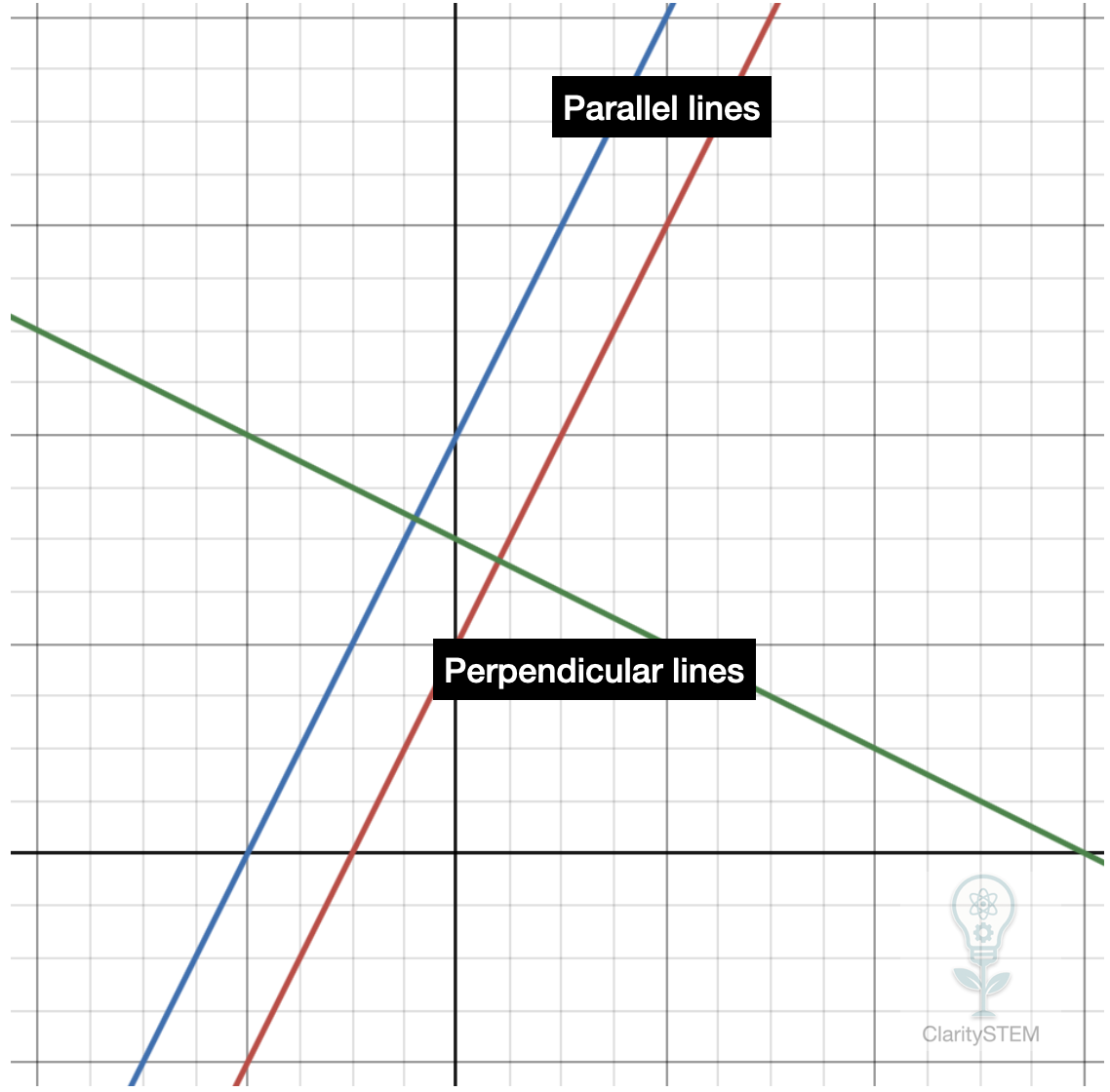
Parallel Lines
Parallel lines have the same gradient.
If a given line has the equation
$$
y = mx + c
$$
then any line parallel to it will also have gradient \( m \) but a different value of \( c \).
Example
The line
$$
y = 3x + 1
$$
has gradient \( 3 \).
A line parallel to it could be
$$
y = 3x - 4
$$
Because the gradients are the same, the lines are parallel and will never meet.
Perpendicular Lines
Perpendicular lines meet at a right angle.
Their gradients multiply to give \( -1 \).
If a line has gradient \( m \), the gradient of a line perpendicular to it is
$$
-\frac{1}{m}
$$
This is called the negative reciprocal.
Example
The line
$$
y = 2x + 5
$$
has gradient \( 2 \).
A perpendicular line has gradient
$$
-\frac{1}{2}
$$
So a perpendicular line could be
$$
y = -\frac{1}{2}x + 3
$$
Finding the Equation of a Required Line
To find the equation of a line that is parallel or perpendicular to another line, first identify the correct gradient.
Then substitute the gradient and a known point into \( y = mx + c \) to find \( c \).
Example
Find the equation of the line perpendicular to
$$
y = -4x + 7
$$
that passes through the point \( (2, 1) \).
The original gradient is \( -4 \).
The perpendicular gradient is
$$
\frac{1}{4}
$$
Substitute the values into the equation:
$$
1 = \frac{1}{4}(2) + c
$$
$$
1 = \frac{1}{2} + c
$$
$$
c = \frac{1}{2}
$$
The equation of the line is
$$
y = \frac{1}{4}x + \frac{1}{2}
$$
Key Points to Remember
Parallel lines have the same gradient.
Perpendicular lines have gradients that multiply to \( -1 \).
To find a perpendicular gradient, use the negative reciprocal.
Once the gradient is known, substitute a point into \( y = mx + c \) to find the equation.
Identifying equations of parallel and perpendicular lines depends on understanding gradients and applying them consistently within straight line equations.