
Identifying Congruent and Similar Shapes
Shapes can be compared to decide whether they are congruent or similar. This involves looking at their sizes, shapes and angles, not just how they are positioned.
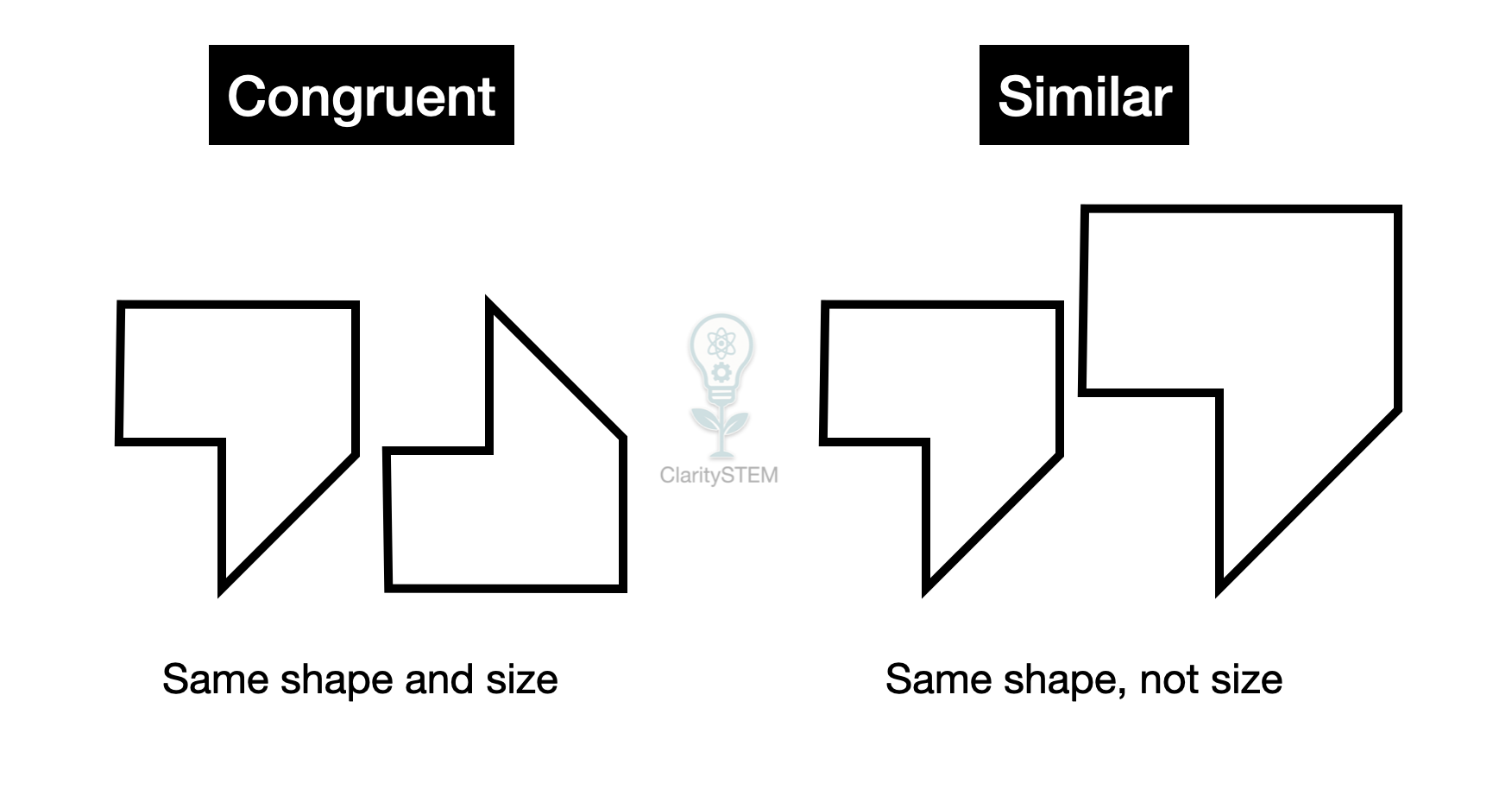
Congruent Shapes
Two shapes are congruent if they are exactly the same size and shape.
This means:
• all corresponding sides are equal in length
• all corresponding angles are equal
• the shapes match perfectly if one is moved, rotated or reflected
Congruent shapes may be:
• in different positions
• rotated
• reflected
These transformations do not change size or shape.
Only rigid movements are allowed for congruence
Examples of congruent shapes include:
• two identical triangles drawn in different orientations
• two rectangles with the same side lengths
If one shape can be placed exactly on top of the other, they are congruent.
Similar Shapes
Two shapes are similar if they have the same shape but are not necessarily the same size.
This means:
• all corresponding angles are equal
• corresponding sides are in the same proportion
One shape is an enlargement or reduction of the other.
The shapes may be:
• larger or smaller
• rotated or reflected
Size can change, shape cannot
Identifying Similar Shapes
To identify similar shapes, check that:
• angles match exactly
• side lengths increase or decrease by the same factor
For example, if every side of one shape is twice as long as the corresponding side of another, the shapes are similar.
If the sides do not scale consistently, the shapes are not similar.
Congruent vs Similar
It is important not to confuse these two ideas.
Congruent shapes:
• same shape
• same size
Similar shapes:
• same shape
• different size
All congruent shapes are similar, but not all similar shapes are congruent.
Common Errors to Avoid
Common mistakes include:
• assuming shapes are similar just because they look alike
• ignoring side length ratios
• forgetting that congruent shapes must be the same size
• thinking orientation affects congruence or similarity
Always compare angles and side lengths carefully
Using Diagrams to Identify Shapes
When shapes are drawn on a grid or diagram:
• compare angles first
• then compare side lengths
• look for consistent enlargement or exact matching
Labelling corresponding sides and angles helps make comparisons clearer.
Key Points to Remember
Congruent shapes have the same size and shape.
Similar shapes have the same shape but may be different sizes.
Corresponding angles must be equal in both cases.
Corresponding sides must be equal for congruence and proportional for similarity.
Rotation and reflection do not affect congruence or similarity.
Being able to identify congruent and similar shapes helps you compare figures accurately and understand how shapes relate to each other in geometry.