
Using Pythagoras’ Theorem in 2-D
Pythagoras’ theorem is used to find missing side lengths in right angled triangles. It applies only when the triangle contains a right angle and is a fundamental tool in geometry.
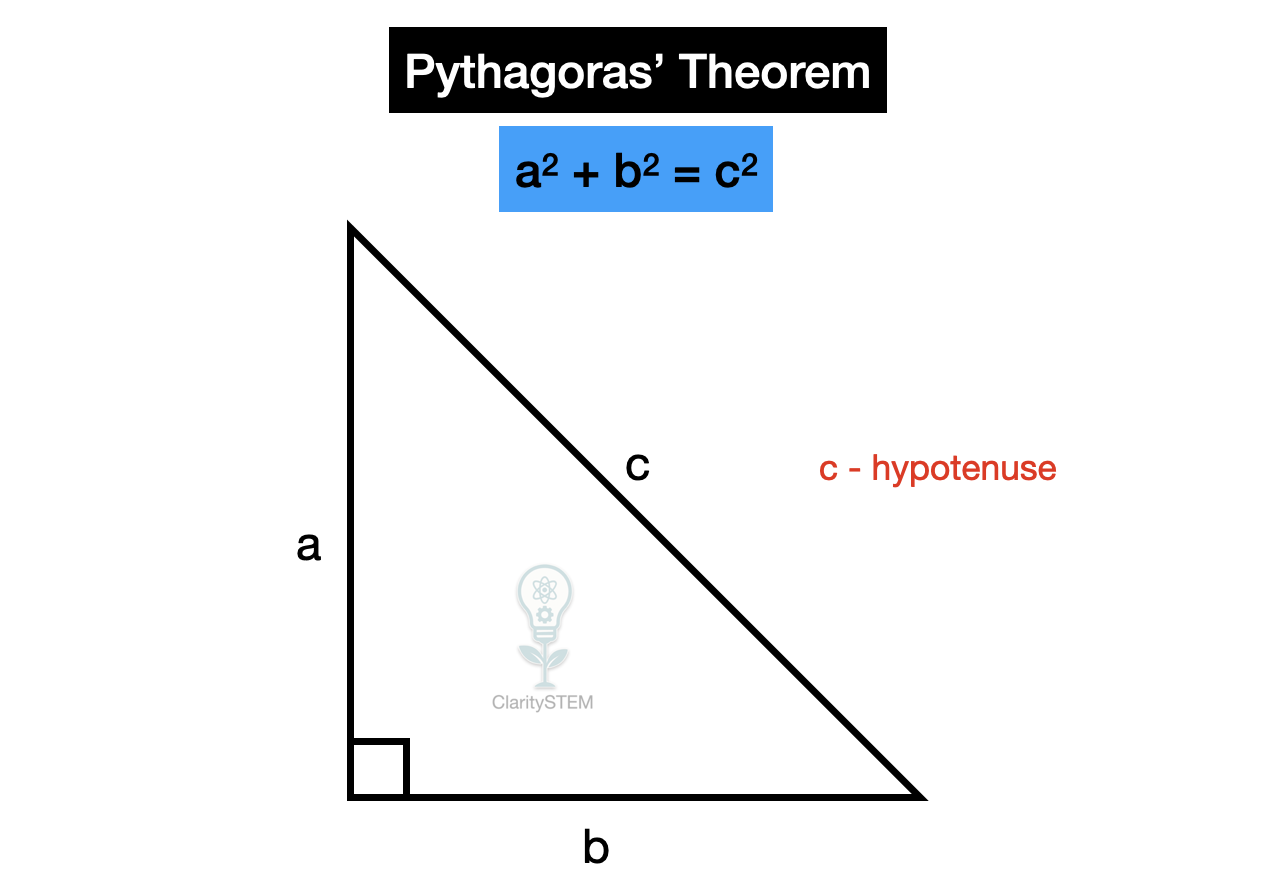
What Pythagoras’ Theorem States
In a right angled triangle, the square of the hypotenuse is equal to the sum of the squares of the other two sides.
The hypotenuse is the longest side and is always opposite the right angle.
Pythagoras’ theorem is written as:
$$
a^2 + b^2 = c^2
$$
where \( c \) is the hypotenuse and \( a \) and \( b \) are the other two sides.
Using Pythagoras’ Theorem to Find a Length
To find a missing side length:
• identify the right angle
• label the hypotenuse correctly
• substitute known values into the formula
• rearrange if necessary
• calculate the answer
Example
A right angled triangle has sides of length 3 cm and 4 cm.
Find the hypotenuse.
$$
3^2 + 4^2 = c^2
$$
$$
9 + 16 = c^2
$$
$$
c^2 = 25
$$
$$
c = 5
$$
The hypotenuse is 5 cm.
Finding a Shorter Side
If the hypotenuse is known, the formula must be rearranged.
Example
The hypotenuse is 13 cm and one shorter side is 5 cm.
Find the other side.
$$
5^2 + b^2 = 13^2
$$
$$
25 + b^2 = 169
$$
$$
b^2 = 144
$$
$$
b = 12
$$
Reverse Pythagoras’ Theorem
Reverse Pythagoras’ theorem is used to check whether a triangle is right angled.
To do this:
• square all three sides
• add the squares of the two shorter sides
• compare with the square of the longest side
If:
$$
a^2 + b^2 = c^2
$$
then the triangle is right angled.
Example
A triangle has sides of length 6 cm, 8 cm and 10 cm.
$$
6^2 + 8^2 = 36 + 64 = 100
$$
$$
10^2 = 100
$$
Since the values are equal, the triangle is right angled.
If the values are not equal, the triangle is not right angled.
Important Conditions
Pythagoras’ theorem:
• only works for right angled triangles
• must use the correct hypotenuse
• requires squared values
Always check for a right angle before using the theorem
Key Points to Remember
Pythagoras’ theorem applies only to right angled triangles.
The hypotenuse is always opposite the right angle.
The formula is \( a^2 + b^2 = c^2 \).
Rearranging allows shorter sides to be found.
Reverse Pythagoras’ theorem checks if a triangle is right angled.
Using Pythagoras’ theorem confidently allows distances and lengths in two dimensional geometry to be found and verified accurately.