
Interpreting 2-D Representations of 3-D Shapes on Isometric Paper
Isometric paper is used to draw and interpret three dimensional shapes on a flat page. It allows depth, width and height to be shown accurately without using perspective.
What Is Isometric Paper
Isometric paper is made up of a grid of equilateral triangles.
The grid creates three sets of parallel lines, each separated by 60 degrees.
These lines represent the three dimensions of space:
• width
• depth
• height
All edges drawn along the grid lines are the same scale, so lengths are not distorted.
Understanding Isometric Drawings
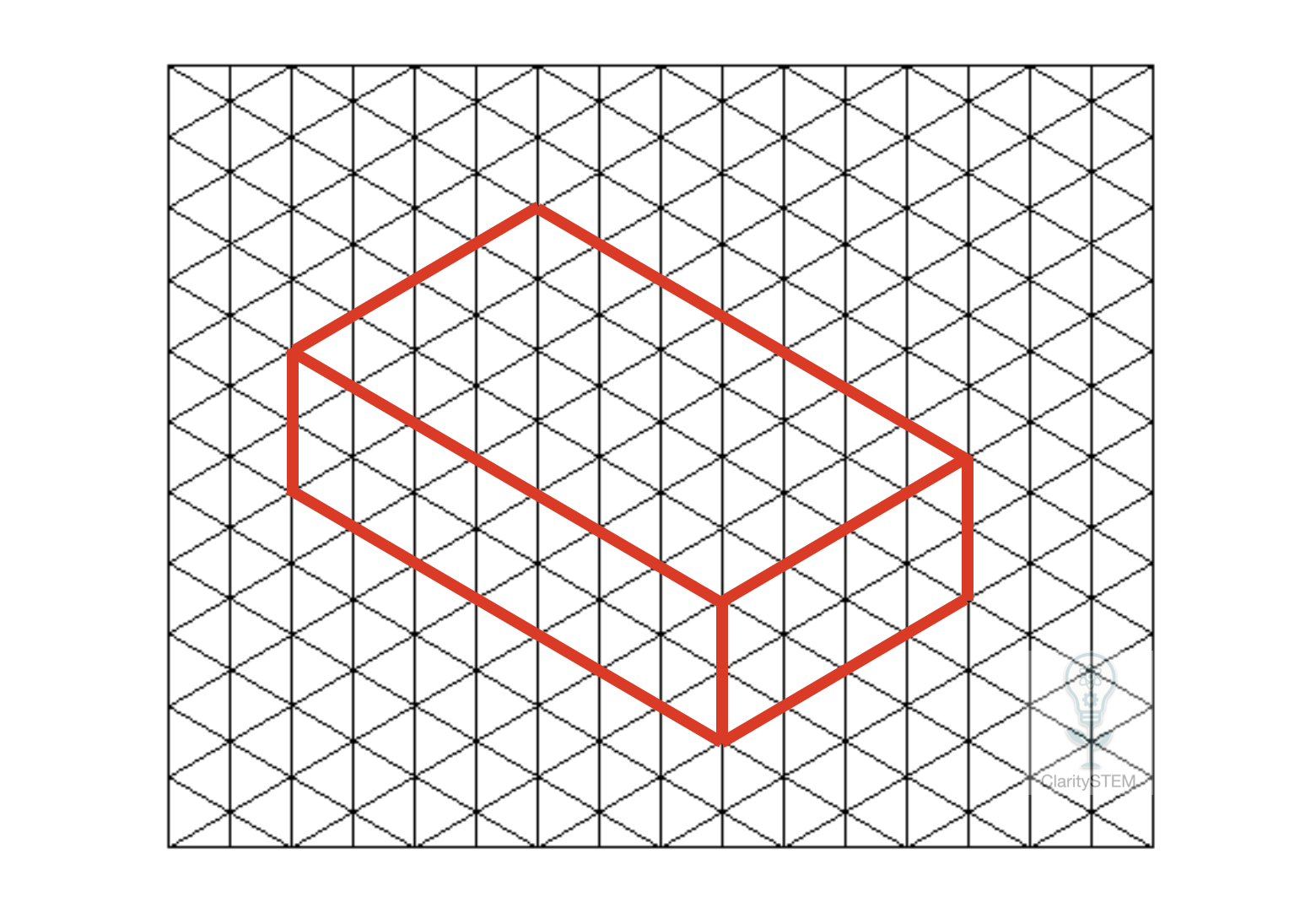
An isometric drawing shows a 3-D shape using the isometric grid.
In an isometric drawing:
• vertical edges are drawn vertically
• horizontal edges are drawn along the slanted grid lines
• parallel edges remain parallel
Faces of the shape appear as parallelograms rather than rectangles or squares.
Interpreting Shape Features
To interpret a 2-D representation on isometric paper, look carefully at how edges and faces are shown.
Identify:
• the number of faces
• the number of edges
• the number of vertices
• how faces join together
Hidden edges are usually not drawn, so you must visualise the parts you cannot see.
Counting Cubes and Volumes
Isometric drawings are often used to show shapes made from cubes.
To interpret these:
• count cubes along each direction of the grid
• check the height by counting vertical layers
• look for cubes hidden behind others
This helps you determine the total number of cubes or the volume of the shape.
Comparing 2-D Drawings to 3-D Shapes
You may be asked to:
• match an isometric drawing to a real 3-D shape
• describe a shape from its isometric view
• identify missing cubes or faces
• draw the shape from another viewpoint
Careful attention to the grid directions is essential.
Common Errors to Avoid
Common mistakes include:
• drawing edges that do not follow the grid
• assuming slanted lines represent height
• missing hidden cubes
• miscounting layers
Always trace edges along the grid lines to avoid errors.
Key Points to Remember
Isometric paper uses a triangular grid to represent 3-D shapes.
Vertical edges are drawn vertically and other edges follow the grid lines.
All lengths are drawn to the same scale.
Hidden parts must be visualised even if not shown.
Isometric drawings help represent and interpret three dimensional shapes accurately.
Interpreting isometric drawings allows you to understand and analyse 3-D shapes clearly using 2-D representations.