
Rotational Symmetry
Rotational symmetry describes when a shape can be rotated around a fixed point and still look exactly the same before a full turn is completed. The fixed point is called the centre of rotation.
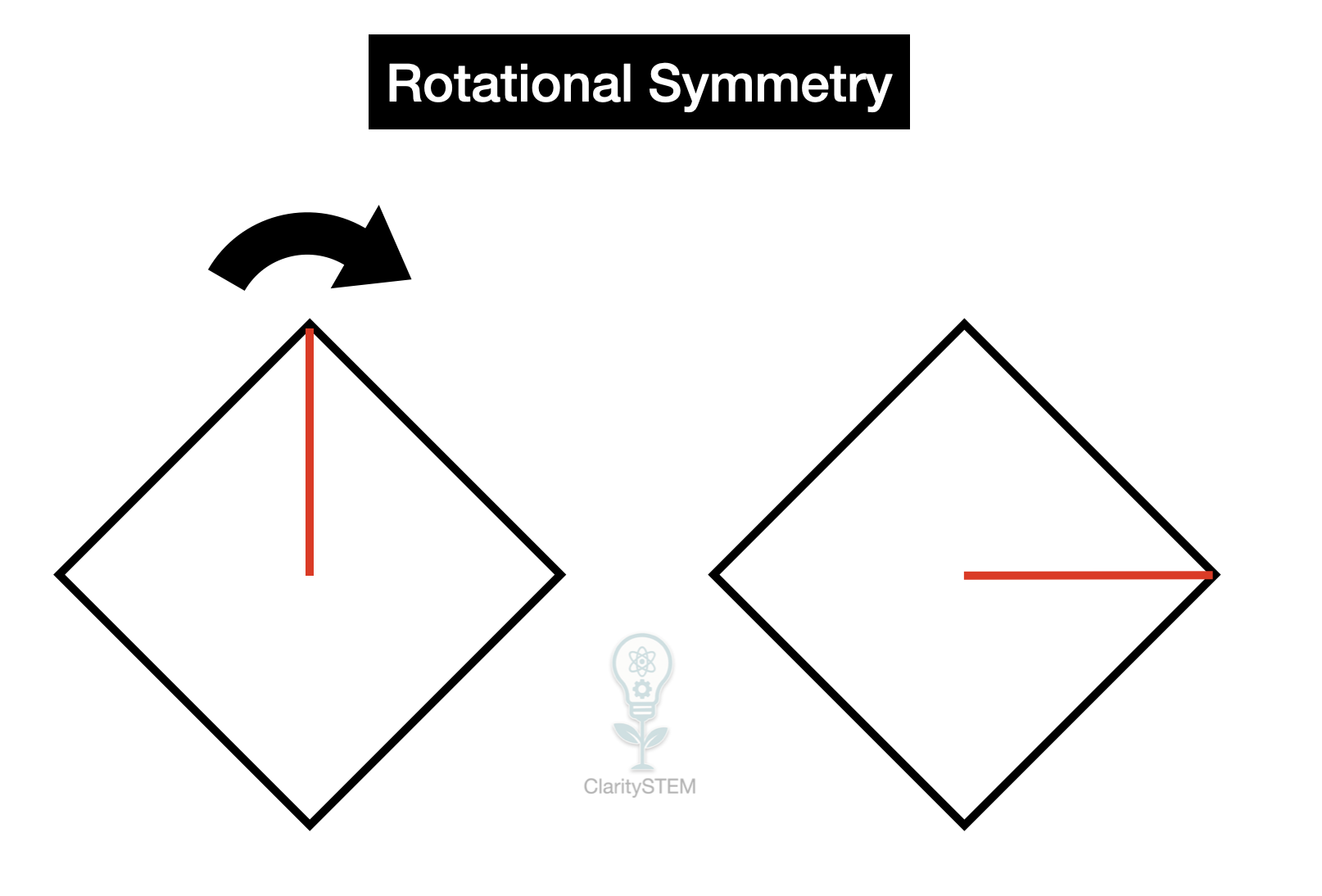
Understanding Rotational Symmetry
A shape has rotational symmetry if it fits exactly onto itself during a rotation of less than
\( 360^\circ \).
The rotation is always measured about the centre of the shape and usually in a clockwise direction.
If a shape only matches itself after a full turn, it has no rotational symmetry other than the trivial full rotation.
Order of Rotational Symmetry
The order of rotational symmetry is the number of times a shape matches itself during one complete turn.
Order of rotational symmetry is found using:
\( \frac{360^\circ}{angle\ of\ rotation} \)
Examples:
A shape with order 2 matches itself every
\( 180^\circ \)
A shape with order 4 matches itself every
\( 90^\circ \)
Higher order means the shape matches itself more frequently during a full turn.
Examples of Rotational Symmetry
A square has rotational symmetry of order 4.
It matches itself at
\( 90^\circ,\ 180^\circ,\ 270^\circ,\ 360^\circ \).
A rectangle has rotational symmetry of order 2.
It matches itself at
\( 180^\circ \).
An equilateral triangle has rotational symmetry of order 3.
It matches itself every
\( 120^\circ \).
A regular hexagon has rotational symmetry of order 6.
A circle has infinite rotational symmetry because it matches itself at every angle.
A scalene triangle has order 1 only.
The centre of rotation is usually the centre of the shape
Describing Rotational Symmetry
When describing rotational symmetry, always state:
• whether the shape has rotational symmetry
• the order of rotational symmetry
• the smallest angle of rotation
For example:
A shape has rotational symmetry of order 3, with a smallest rotation of
\( 120^\circ \).
Drawing Shapes with Rotational Symmetry
To draw a shape with rotational symmetry:
• choose a centre of rotation
• decide the order of symmetry
• divide a full turn evenly between repeats
• draw one part of the shape
• rotate it repeatedly about the centre
Each rotated part must be the same size and shape.
When using squared paper, keeping distances from the centre equal helps maintain accuracy.
The shape must look identical after each rotation
Key Points to Remember
Rotational symmetry involves turning a shape around a centre point.
The order tells how many times the shape matches itself in a full turn.
The smallest angle of rotation is found by dividing
\( 360^\circ \) by the order.
Regular shapes usually have rotational symmetry.
Some shapes have no rotational symmetry other than a full turn.
Understanding rotational symmetry helps describe, classify and construct shapes accurately in geometry.