
Using Coordinates in All Four Quadrants
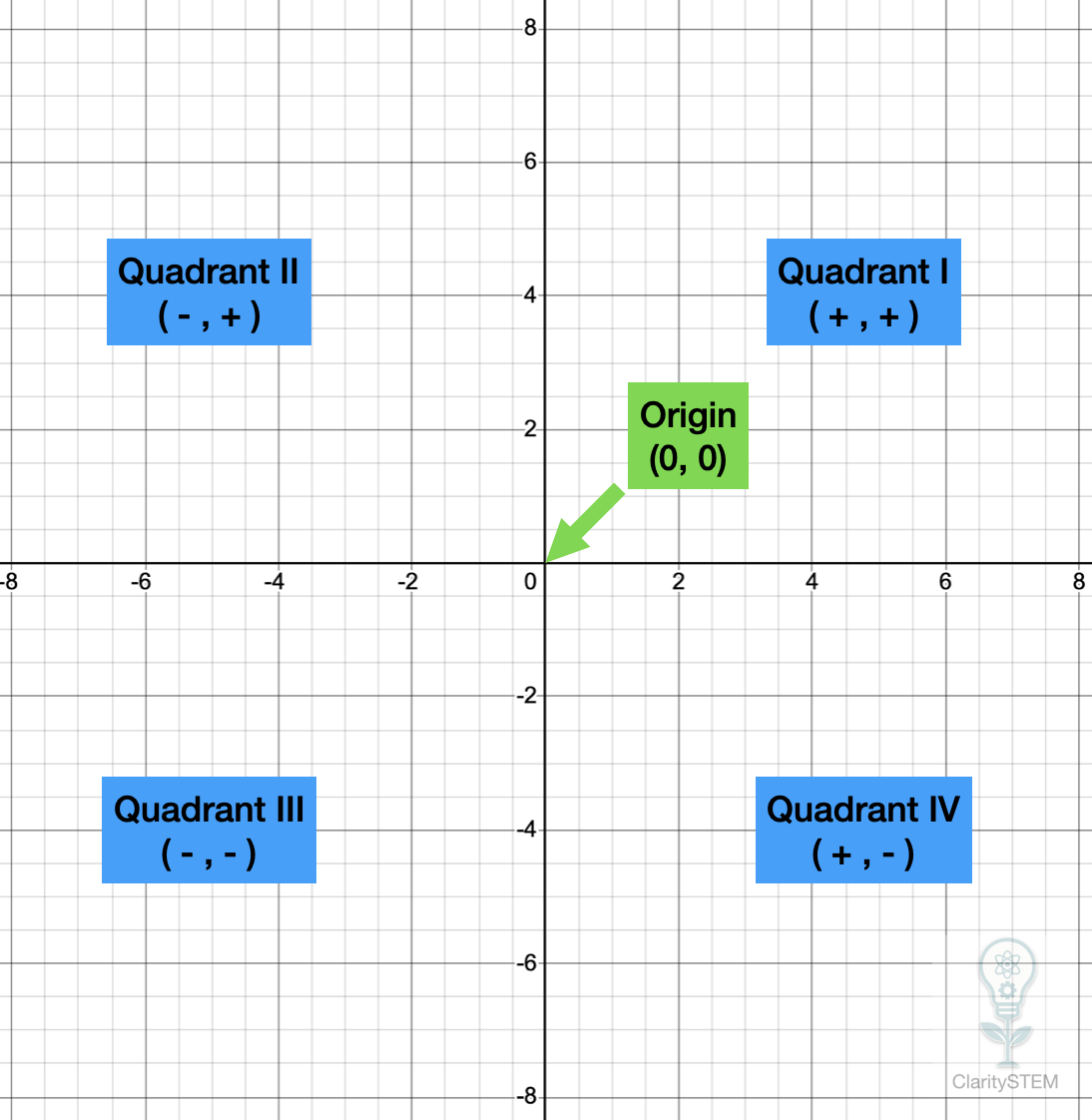
The coordinate plane is formed by two number lines that cross at right angles. These are called the x axis (horizontal) and the y axis (vertical). The point where they cross is called the origin.
$$
(0,\ 0)
$$
The plane is divided into four quadrants, which allow points with both positive and negative coordinates to be plotted.
Understanding Coordinates
A coordinate is written in the form:
$$
(x,\ y)
$$
The first number, \( x \), tells you how far to move left or right from the origin.
The second number, \( y \), tells you how far to move up or down from the origin.
Always move in the x direction first, then the y direction.
The Four Quadrants
Each quadrant has a different combination of positive and negative values.
Quadrant 1
\( x \) is positive and \( y \) is positive
For example:
$$
(3,\ 4)
$$
Quadrant 2
\( x \) is negative and \( y \) is positive
For example:
$$
(-2,\ 5)
$$
Quadrant 3
\( x \) is negative and \( y \) is negative
For example:
$$
(-4,\ -1)
$$
Quadrant 4
\( x \) is positive and \( y \) is negative
For example:
$$
(6,\ -3)
$$
The quadrants are numbered anticlockwise, starting from the top right.
Plotting Points in All Four Quadrants
To plot a point:
- Start at the origin
- Move left or right according to the x coordinate
- Move up or down according to the y coordinate
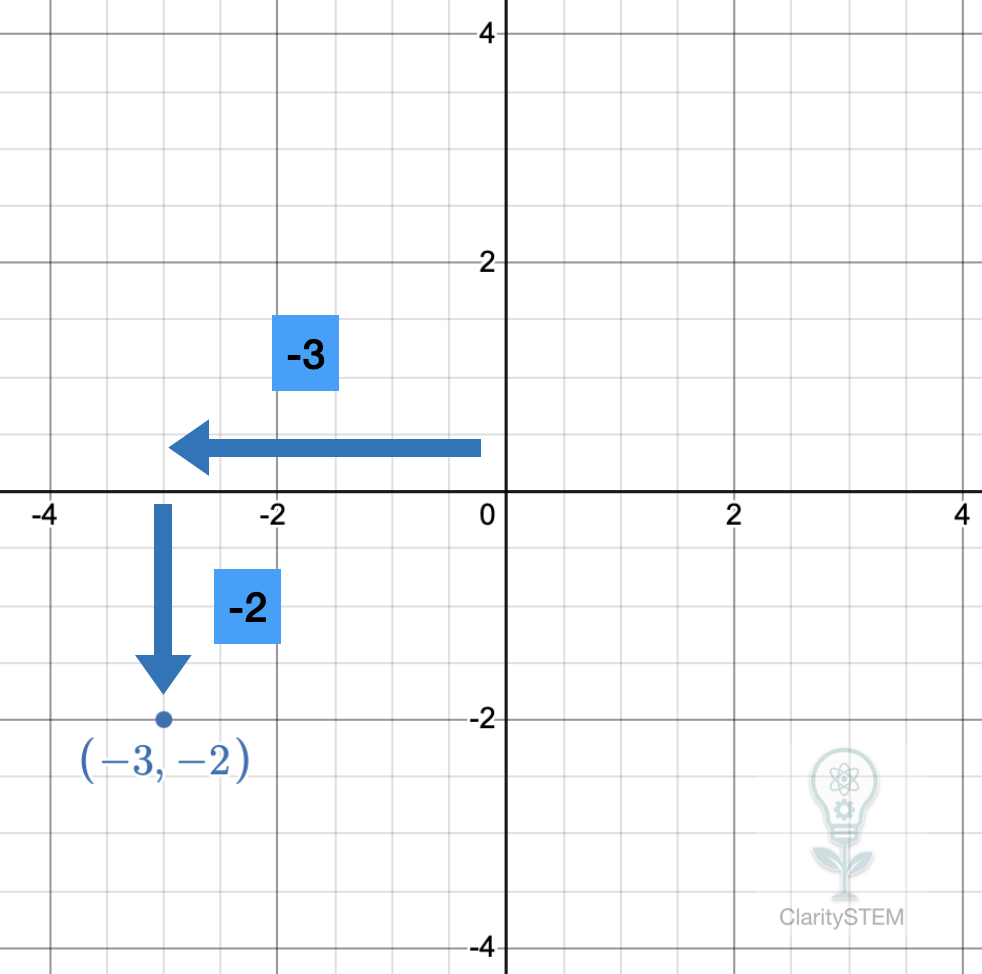
For example, to plot:
$$
(-3,\ -2)
$$
Move 3 units left, then 2 units down. This point lies in Quadrant 3.
Reading Coordinates from a Graph
To read the coordinates of a point on a graph:
- Read the x coordinate from the horizontal axis
- Read the y coordinate from the vertical axis
For example, if a point is 2 units left and 4 units up from the origin, its coordinates are:
$$
(-2,\ 4)
$$
This point lies in Quadrant 2.
Points on the Axes
If a point lies on an axis, one of its coordinates is zero.
For example:
$$
(5,\ 0)
$$
This point lies on the x axis.
$$
(0,\ -3)
$$
This point lies on the y axis.
Points on the axes are not in any quadrant.
Key Points to Remember
Coordinates are written as \( (x,\ y) \).
The x coordinate comes first, then the y coordinate.
There are four quadrants with different sign combinations.
Quadrants are numbered anticlockwise starting from the top right.
Points on the axes are not in any quadrant.
Using coordinates confidently in all four quadrants is essential for graph work, geometry and many real world applications involving position and movement.