
The Vocabulary of Probability
Probability is used to describe how likely an event is to happen. It helps us deal with uncertainty and make decisions where outcomes are not guaranteed. Using correct probability vocabulary allows events and situations to be described clearly and accurately.
Probability and Uncertainty
Uncertainty means that the outcome of an event is not known in advance.
Some events are:
• completely certain
• completely impossible
• somewhere in between
Probability provides a way to measure this uncertainty.
An event with high probability is likely to happen.
An event with low probability is unlikely to happen.
Uncertainty exists in many real life situations such as weather forecasts, games of chance and risk based decisions.
Probability Vocabulary
An experiment is an action or process with an outcome that cannot be predicted with certainty, such as tossing a coin.
An outcome is a possible result of an experiment.
An event is one or more outcomes.
For example, getting a head when tossing a coin is an event.
A sample space is the set of all possible outcomes of an experiment.
An event is certain if it will definitely happen.
An event is impossible if it cannot happen.
An event is likely if it has a high chance of happening.
An event is unlikely if it has a low chance of happening.
An event is equally likely when all outcomes have the same chance.
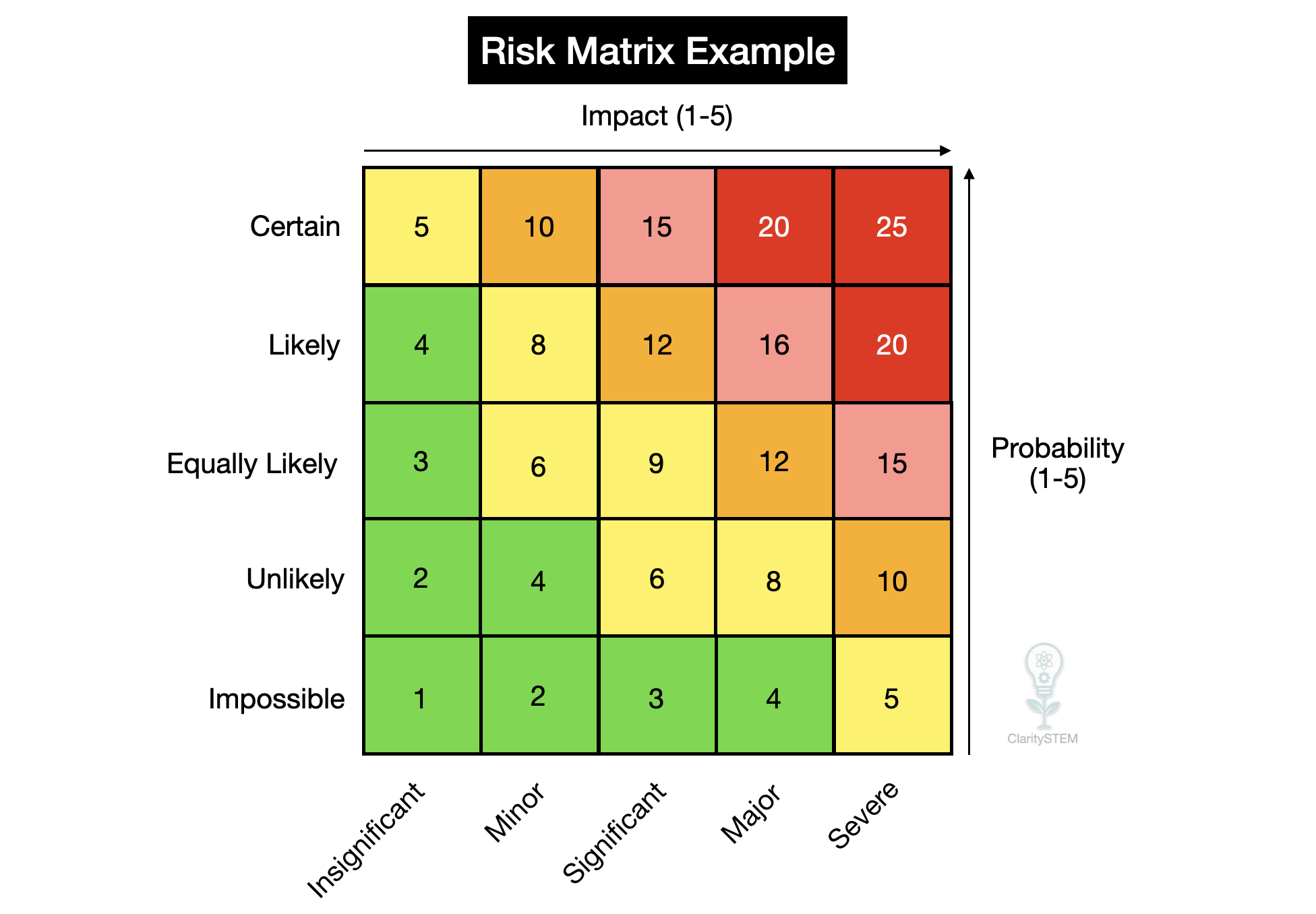
Describing Probability
Probability can be described using words, numbers or diagrams.
Verbal descriptions include words such as:
• certain
• likely
• unlikely
• impossible
These words give a general sense of chance but are not precise.
More precise descriptions use numerical probability values.
The probability of an event is always between zero and one.
A probability of zero means the event is impossible.
A probability of one means the event is certain.
Risk
Risk is linked to probability but also considers the consequences of an outcome.
A situation with:
• low probability but severe consequences
• high probability but minor consequences
can both involve risk.
Risk is often assessed by considering:
• how likely something is to happen
• how serious the outcome would be
Understanding risk helps in making informed decisions.
Using Probability Vocabulary Correctly
When using probability vocabulary:
• choose words that match how likely the event is
• avoid vague or misleading descriptions
• be consistent in language
For example, calling an event certain when it is only likely is incorrect.
Clear vocabulary leads to clearer reasoning.
Key Points to Remember
Probability describes how likely events are.
Uncertainty means outcomes are not guaranteed.
Events can be certain, impossible or somewhere in between.
Probability values lie between zero and one.
Risk combines likelihood with consequence.
Accurate vocabulary is essential for clear communication.
Understanding the vocabulary of probability allows uncertainty and risk to be described clearly and supports better reasoning in both mathematical and real life contexts.