
Extending Trigonometry to Angles of Any Size
⭐ Higher Tier Content
Trigonometry can be extended beyond right angled triangles to work with angles of any size, including angles greater than
\( 90^\circ \)
and angles greater than
\( 360^\circ \).
This allows trigonometric functions to be used more generally in geometry and algebra.
Why Trigonometry Needs Extending
In right angled triangles, sine, cosine and tangent are defined using side lengths.
However, many problems involve:
• obtuse angles
• reflex angles
• full rotations
• angles on graphs
To handle these cases, trigonometric functions are defined using a circle rather than a triangle.
The Unit Circle Idea
Trigonometric values can be defined using a circle centred at the origin.
An angle \( \theta \) is measured from the positive x axis, rotating anticlockwise.
For any angle:
• the x coordinate gives the cosine value
• the y coordinate gives the sine value
This allows sine and cosine to be defined for all angles, not just those in triangles.
Sine and Cosine for Any Angle
Sine and cosine values repeat in a regular pattern.
Key angles to recognise include:
• \( 0^\circ \)
• \( 90^\circ \)
• \( 180^\circ \)
• \( 270^\circ \)
• \( 360^\circ \)
For example:
$$
\sin 0^\circ = 0
$$
$$
\cos 180^\circ = -1
$$
Negative values occur because coordinates on the circle can be negative.
Using Trigonometric Graphs
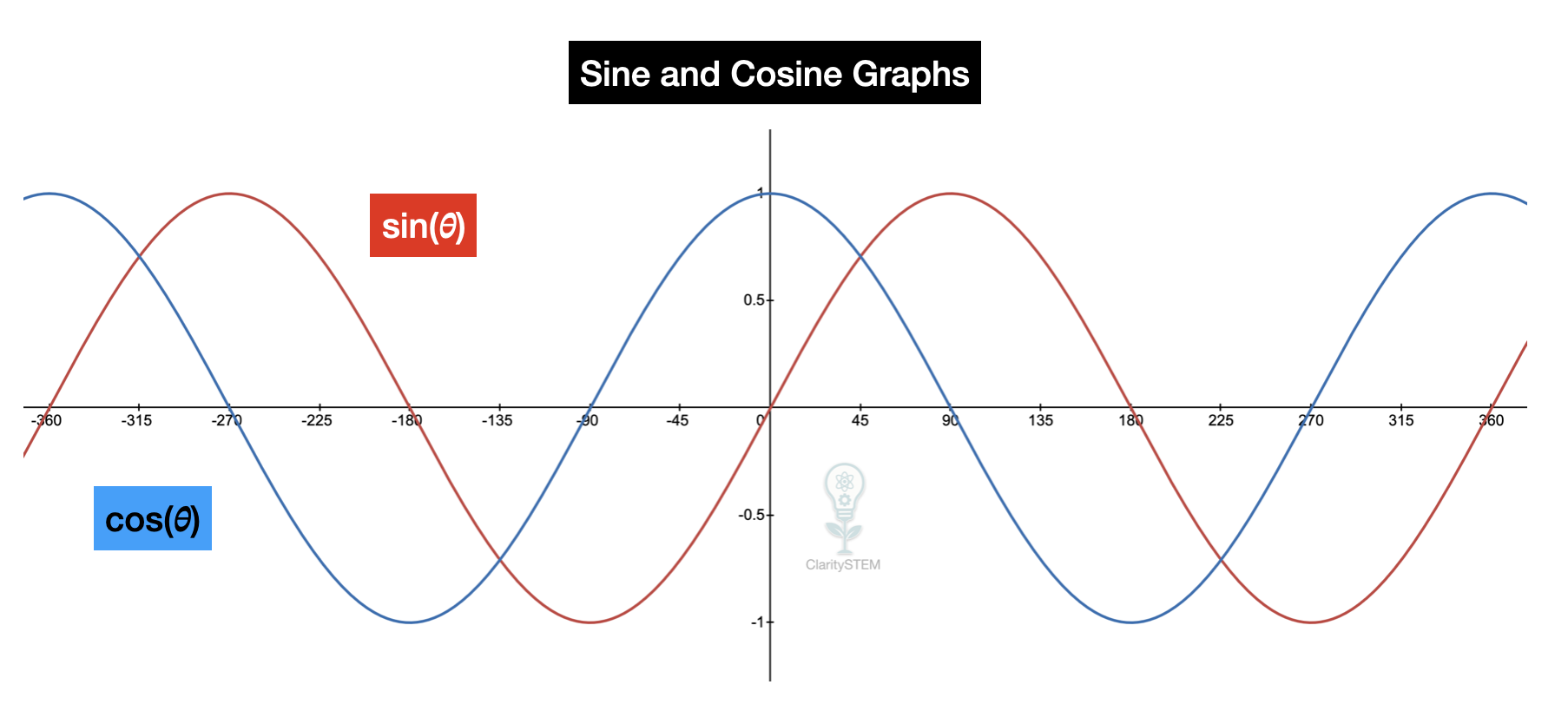
The graphs of \( \sin \theta \) and \( \cos \theta \) show how these values change as the angle increases.
Important features include:
• periodic repetition every \( 360^\circ \)
• maximum value of 1
• minimum value of -1
This explains why sine and cosine always lie between -1 and 1.
Tangent for Any Angle
Tangent is defined using sine and cosine.
$$
\tan \theta = \frac{\sin \theta}{\cos \theta}
$$
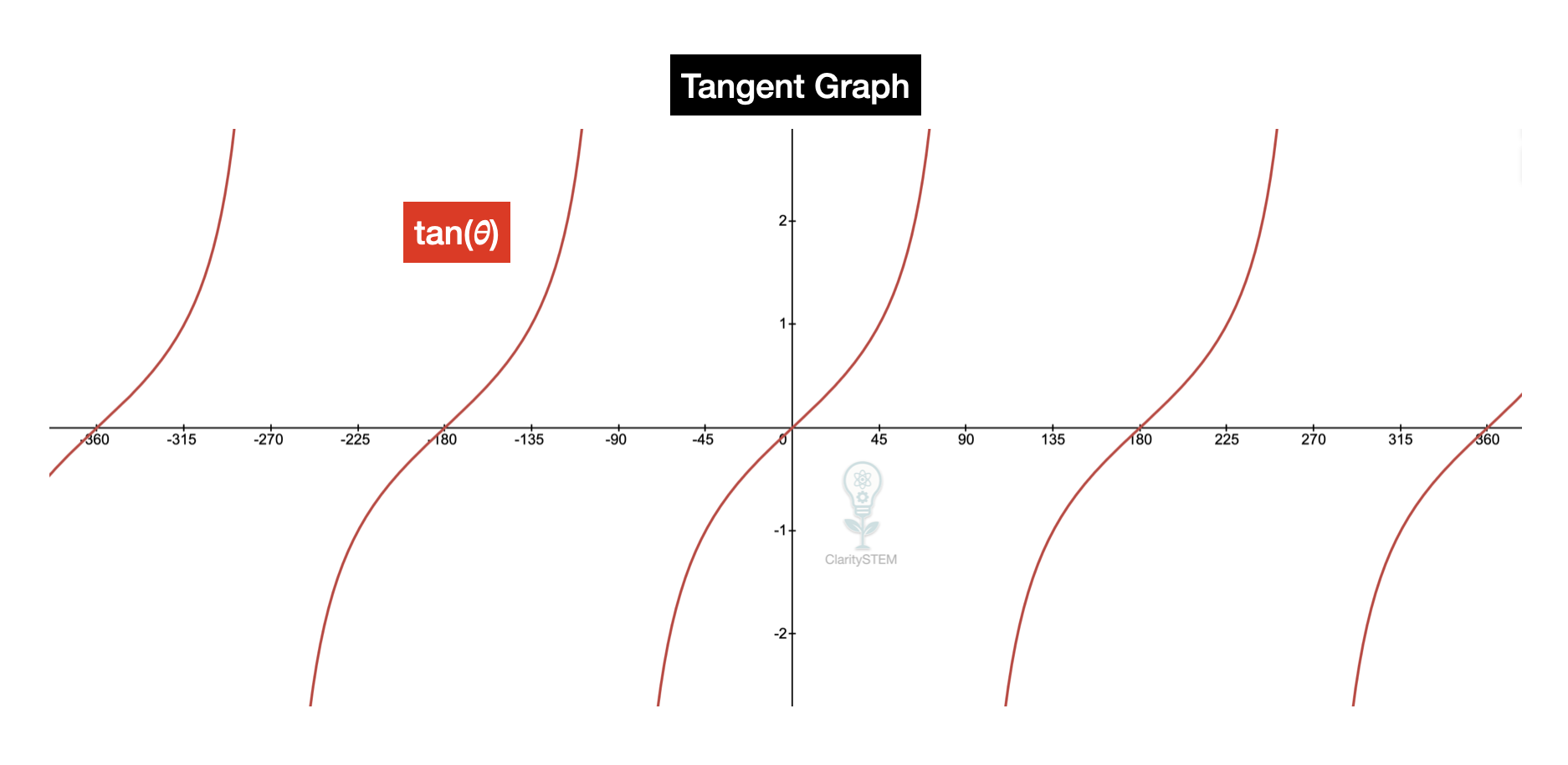
Tangent can take any real value.
Tangent is undefined when:
$$
\cos \theta = 0
$$
This happens at angles such as:
\( 90^\circ \)
and
\( 270^\circ \)
Trigonometric Equations with Any Angle
When solving trigonometric equations, angles can have more than one solution.
This is because sine, cosine and tangent repeat.
For example:
$$
\sin \theta = \frac{1}{2}
$$
has solutions such as:
\( 30^\circ \)
and
\( 150^\circ \)
Additional solutions can be found by adding multiples of
\( 360^\circ \).
Always check how many solutions are required
Using Trigonometry Beyond Triangles
Extending trigonometry allows it to be used in:
• solving equations
• interpreting graphs
• modelling circular motion
• problems involving rotation
Angles are no longer limited to triangles.
Key Points to Remember
Trigonometry can be defined for angles of any size.
Angles are measured from the positive x axis anticlockwise.
Sine and cosine values lie between -1 and 1.
Tangent is sine divided by cosine.
Trigonometric functions repeat every \( 360^\circ \).
Equations may have more than one solution.
Extending trigonometry allows angles of any size to be analysed and used confidently in algebraic, graphical and geometric contexts.