
Area and Perimeter of 2-D Shapes
This topic covers how to estimate the area of irregular shapes and how to calculate the perimeter and area of common two dimensional shapes. Accurate use of units and formulas is essential.
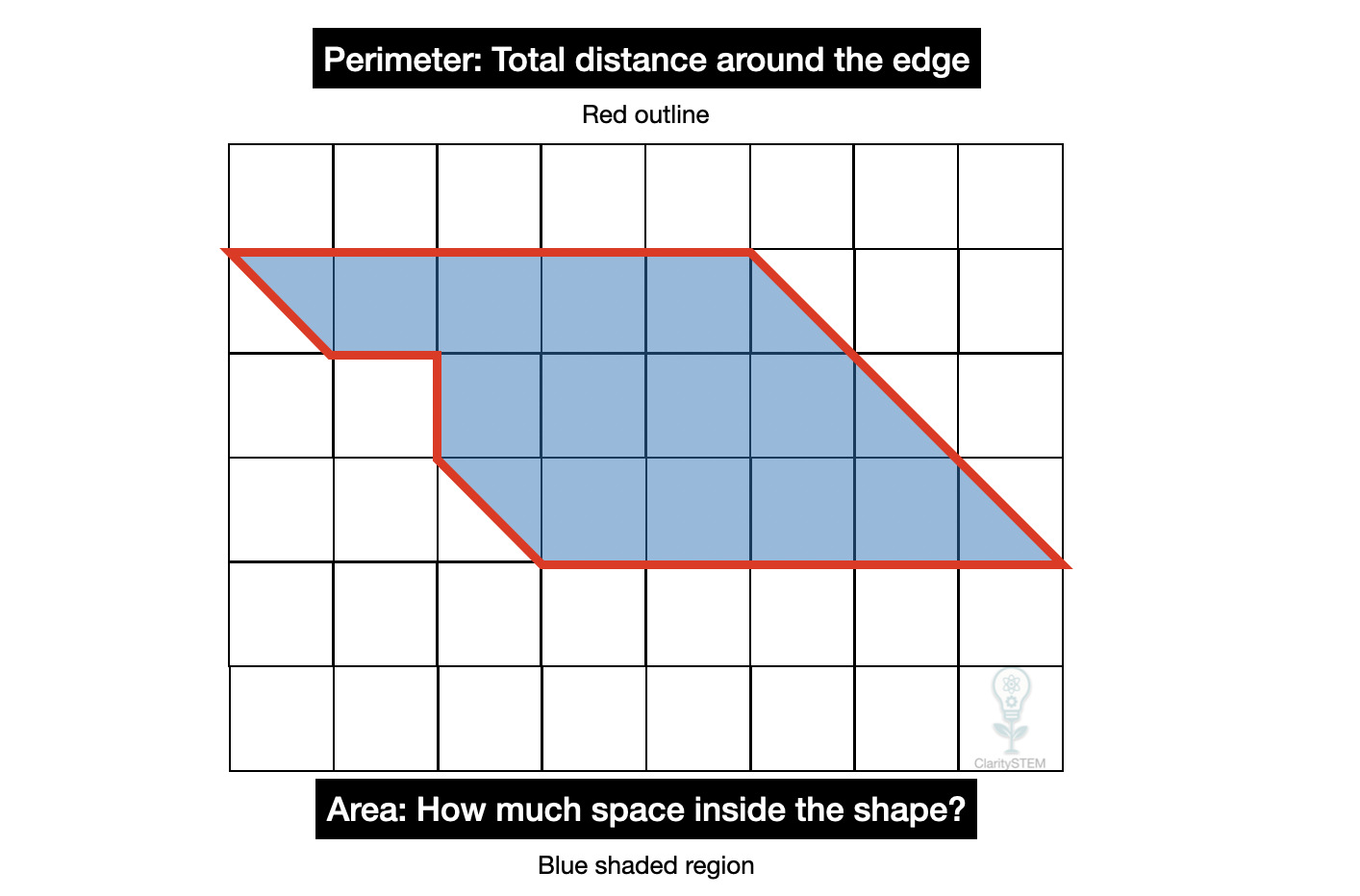
Estimating the Area of an Irregular Shape on a Square Grid
An irregular shape does not have a standard formula for its area.
When an irregular shape is drawn on a square grid, its area can be estimated by counting squares.
To estimate the area:
• count the number of full squares inside the shape
• count squares that are more than half covered as full squares
• ignore or pair up smaller parts of squares
The estimated area is:
number of squares × area of one square
This method gives an estimate, not an exact value
Perimeter
The perimeter of a shape is the total distance around its edge.
Perimeter is found by adding the lengths of all sides.
Perimeter is measured in units of length, such as centimetres or metres.
Area of a Square
A square has four equal sides.
Area of a square is given by:
$$
area = side^2
$$
Perimeter of a square is given by:
$$
perimeter = 4 \times side
$$
Area of a Rectangle
A rectangle has opposite sides equal.
Area of a rectangle is given by:
$$
area = length \times width
$$
Perimeter of a rectangle is given by:
$$
perimeter = 2(length + width)
$$
Area of a Triangle
The area of a triangle depends on its base and perpendicular height.
Area of a triangle is given by:
$$
area = \frac{1}{2} \times base \times height
$$
The height must be perpendicular to the base.
Area of a Parallelogram
A parallelogram has opposite sides parallel and equal.
Area of a parallelogram is given by:
$$
area = base \times height
$$
The height is the perpendicular distance between the parallel sides.
Area of a Trapezium
A trapezium has one pair of parallel sides.
Area of a trapezium is given by:
$$
area = \frac{1}{2} (a + b) \times h
$$
where \( a \) and \( b \) are the parallel sides and \( h \) is the perpendicular height.
Area and Perimeter of a Circle
A circle is measured using its radius.
Area of a circle is given by:
$$
area = \pi r^2
$$
Circumference of a circle is given by:
$$
circumference = 2\pi r
$$
Area of a Semicircle
A semicircle is half of a circle.
Area of a semicircle is:
$$
area = \frac{1}{2}\pi r^2
$$
The perimeter of a semicircle includes:
• half the circumference
• the diameter
Composite Shapes
A composite shape is made by combining two or more simple shapes.
To find the area:
• split the shape into known shapes
• find the area of each part
• add or subtract areas as needed
To find the perimeter:
• add only the outer edges
• do not include internal edges
Working step by step helps avoid mistakes.
Key Points to Remember
Irregular areas can be estimated using square grids.
Perimeter is the distance around a shape.
Area measures the space inside a shape.
Each shape has a specific area formula.
Composite shapes must be split into simpler shapes.
Being confident with area and perimeter allows you to solve practical and geometric problems involving space and measurement accurately.