
Angle Properties
Angle properties are rules that always apply to angles in particular situations. Being able to recall and use these angle properties allows unknown angles to be found accurately and efficiently.
Sum of Angles at a Point
Angles around a point make a full turn.
The sum of angles at a point is
\( 360^\circ \)
This means that all angles meeting at a single point add up to 360 degrees.
If several angles meet at a point and some are known, the remaining angles can be found by subtracting from \( 360^\circ \).
Sum of Angles on a Straight Line
Angles on a straight line form a half turn.
The sum of angles on a straight line is
\( 180^\circ \)
If two or more angles lie on a straight line, they add up to 180 degrees.
Angles that share a straight line are sometimes described as supplementary.
Opposite Angles at a Vertex
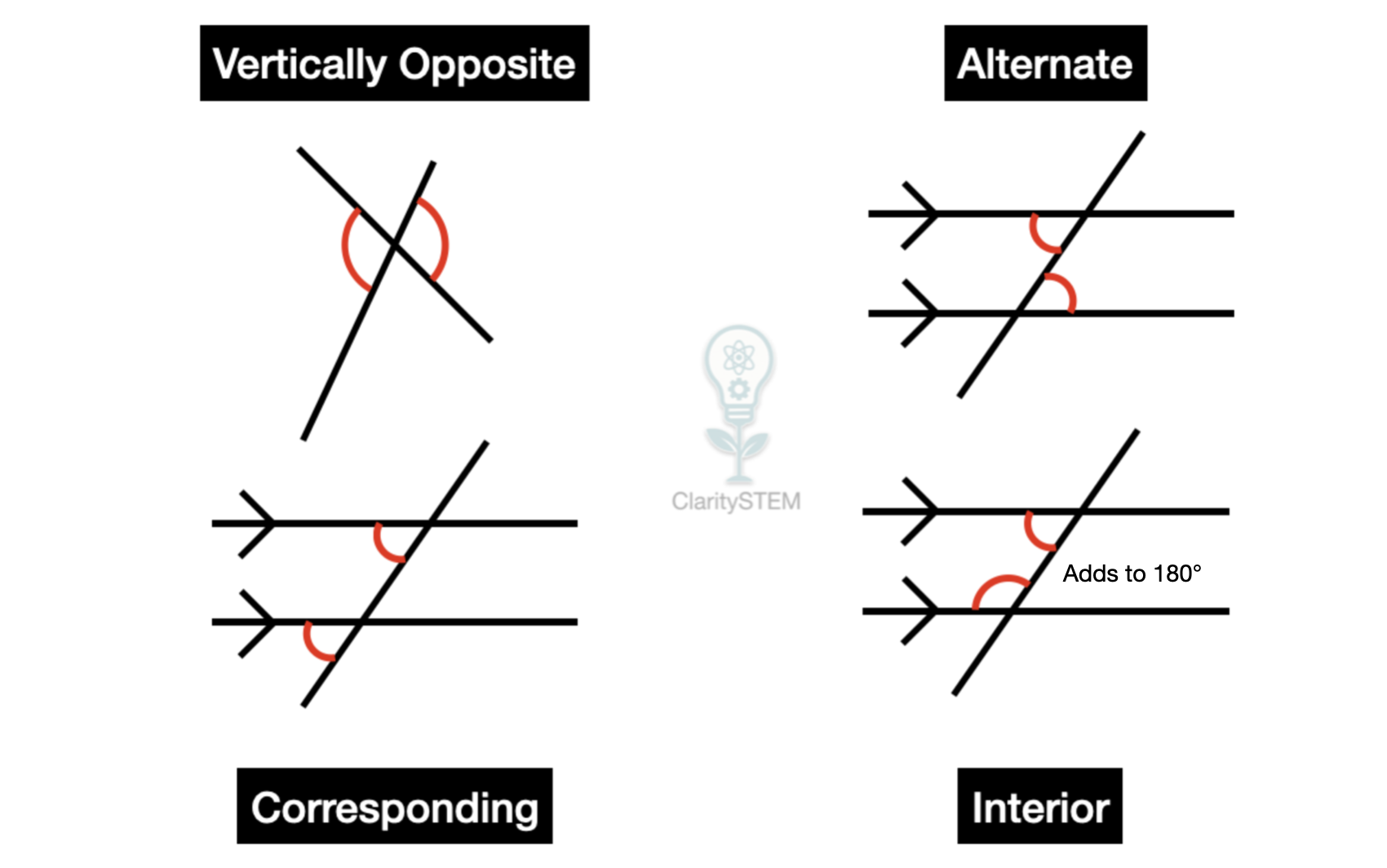
When two straight lines cross, they form vertically opposite angles.
Opposite angles at a vertex are equal.
This means that if one angle is known, the angle directly opposite it has the same value.
Alternate, Corresponding and Interior Angles
These angle properties apply when a transversal crosses two parallel lines.
Alternate angles are equal.
Corresponding angles are equal.
Interior angles on the same side of the transversal add up to \( 180^\circ \).
These rules only apply if the lines are parallel, which must be stated or shown.
Always check that the lines are parallel before using these properties
Sum of Angles in a Triangle
The interior angles of any triangle add up to
\( 180^\circ \)
This applies to all types of triangles, including scalene, isosceles, equilateral and right angled triangles.
If two angles in a triangle are known, the third angle can be found by subtracting their sum from \( 180^\circ \).
Key Points to Remember
Angles at a point add up to \( 360^\circ \).
Angles on a straight line add up to \( 180^\circ \).
Opposite angles at a vertex are equal.
Alternate and corresponding angles are equal in parallel lines.
Interior angles on the same side add up to \( 180^\circ \).
The angles in a triangle add up to \( 180^\circ \).
Angle properties provide reliable rules that allow unknown angles to be calculated accurately in a wide range of geometric problems.