
Dependent Events
⭐ Higher Tier Content
Some probability problems involve dependent events. These occur when the outcome of one event affects the probability of the next event. This commonly happens in sampling without replacement. Recognising dependence is essential so that probabilities are calculated correctly.
Understanding Dependent Events
Events are dependent if the result of one event changes the probability of another event.
This happens when:
• items are not replaced after being selected
• the sample size is small compared to the population
• previous outcomes affect later choices
For example, picking counters from a bag without replacing them creates dependent events.
Probabilities change after each outcome
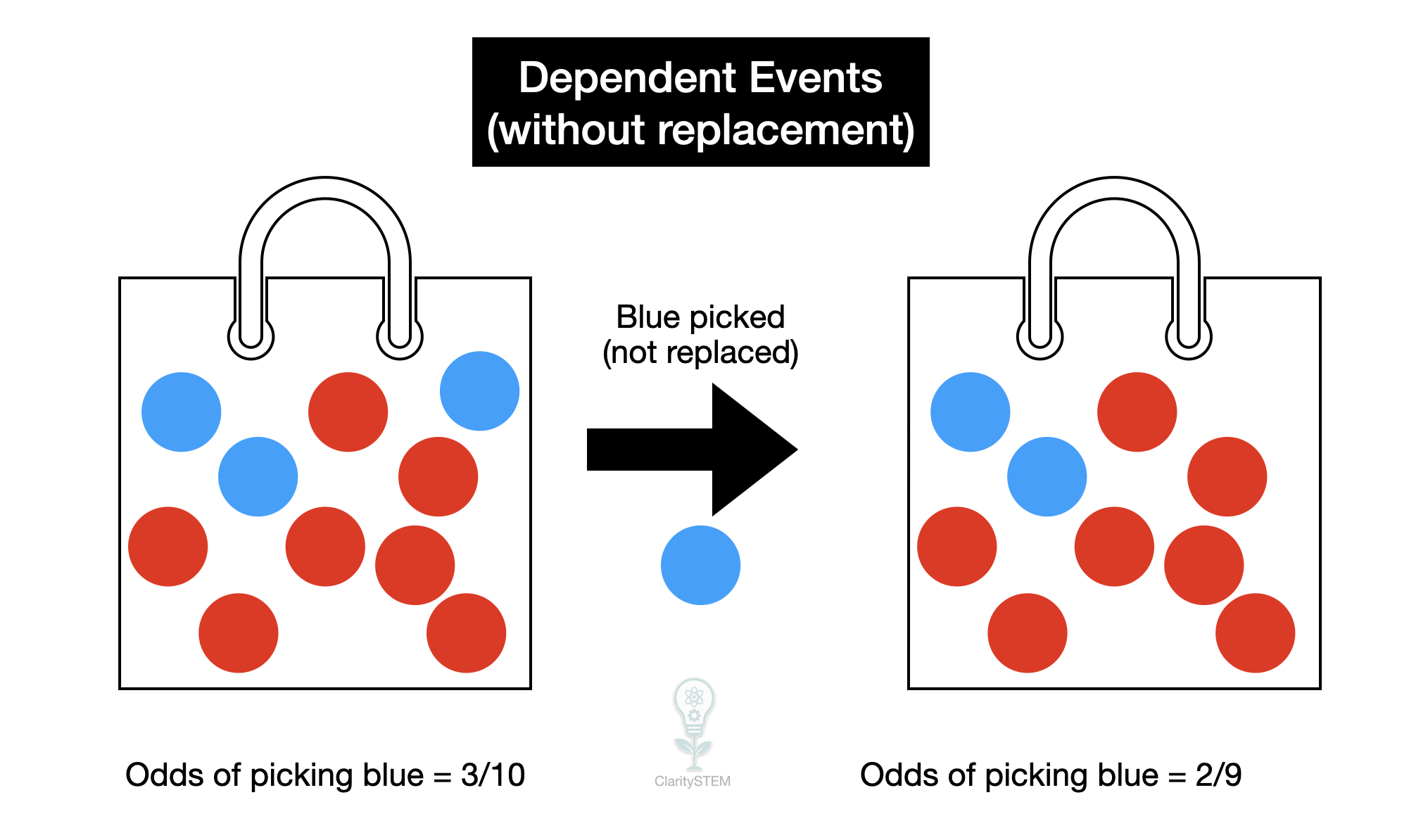
Recognising Dependent Event Problems
Problems involve dependent events when:
• items are taken without replacement
• selections are made one after another
• the question states that objects are not returned
• probabilities change between stages
Key wording clues include:
• “without replacement”
• “not replaced”
• “then”
• “after”
If probabilities are different on later stages, the events are dependent.
Two Dependent Events
When two events are dependent, the probability of both events occurring is found by multiplying the probability of the first event by the conditional probability of the second event.
This is written as:
\( P(A\ and\ B) = P(A) \times P(B\ given\ A) \)
The second probability is calculated after the first event has occurred.
For example, if an item is removed, the total number of possible outcomes changes.
The second probability depends on the first outcome
Three Dependent Events
When three events are dependent, the probability is found by multiplying three probabilities, each adjusted for previous outcomes.
This is written as:
\( P(A\ and\ B\ and\ C) = P(A) \times P(B\ given\ A) \times P(C\ given\ A\ and\ B) \)
Each probability reflects the situation at that stage of the experiment.
The sample size reduces after each selection if items are not replaced.
Sampling Without Replacement
Sampling without replacement means:
• once an item is chosen, it is not returned
• the total number of items decreases
• probabilities change at each step
This always creates dependent events.
Tree diagrams are especially useful for these problems because they clearly show how probabilities change along each branch.
Interpreting the Result
The calculated probability represents the chance that the entire sequence of outcomes occurs in that order.
The result:
• depends on the order of events
• is usually smaller than individual probabilities
• reflects increasing restriction as selections are made
Order matters in dependent event problems.
Common Errors to Avoid
Common mistakes include:
• treating dependent events as independent
• failing to adjust probabilities after a selection
• assuming replacement when there is none
• adding probabilities instead of multiplying
Always check whether probabilities change between stages.
Key Points to Remember
Dependent events affect each other’s probabilities.
Sampling without replacement creates dependent events.
Probabilities must be adjusted after each outcome.
Two dependent events use a conditional probability.
Three dependent events require probabilities at each stage.
Tree diagrams help organise dependent event calculations.
Recognising and correctly calculating probabilities for two or three dependent events ensures accurate handling of real world sampling situations and avoids common probability errors.