
Drawing and Interpreting Cubic Graphs
⭐ Higher Tier Content
This topic focuses on recognising, sketching and interpreting cubic graphs written in different algebraic forms. Cubic graphs have distinctive shapes and key features that can be identified from their equations.
Cubic Graphs of the Form y = ax³ + b
Equations of this form produce cubic graphs that are simple transformations of the basic cubic curve.
The equation is written as
\( y = ax^3 + b \)
All graphs of this type have a smooth curve and continue infinitely in both directions.
The value of a affects the steepness and direction of the graph.
a positive value of a makes the graph rise from bottom left to top right
a negative value of a makes the graph fall from top left to bottom right
The value of b moves the graph up or down and gives the y intercept.
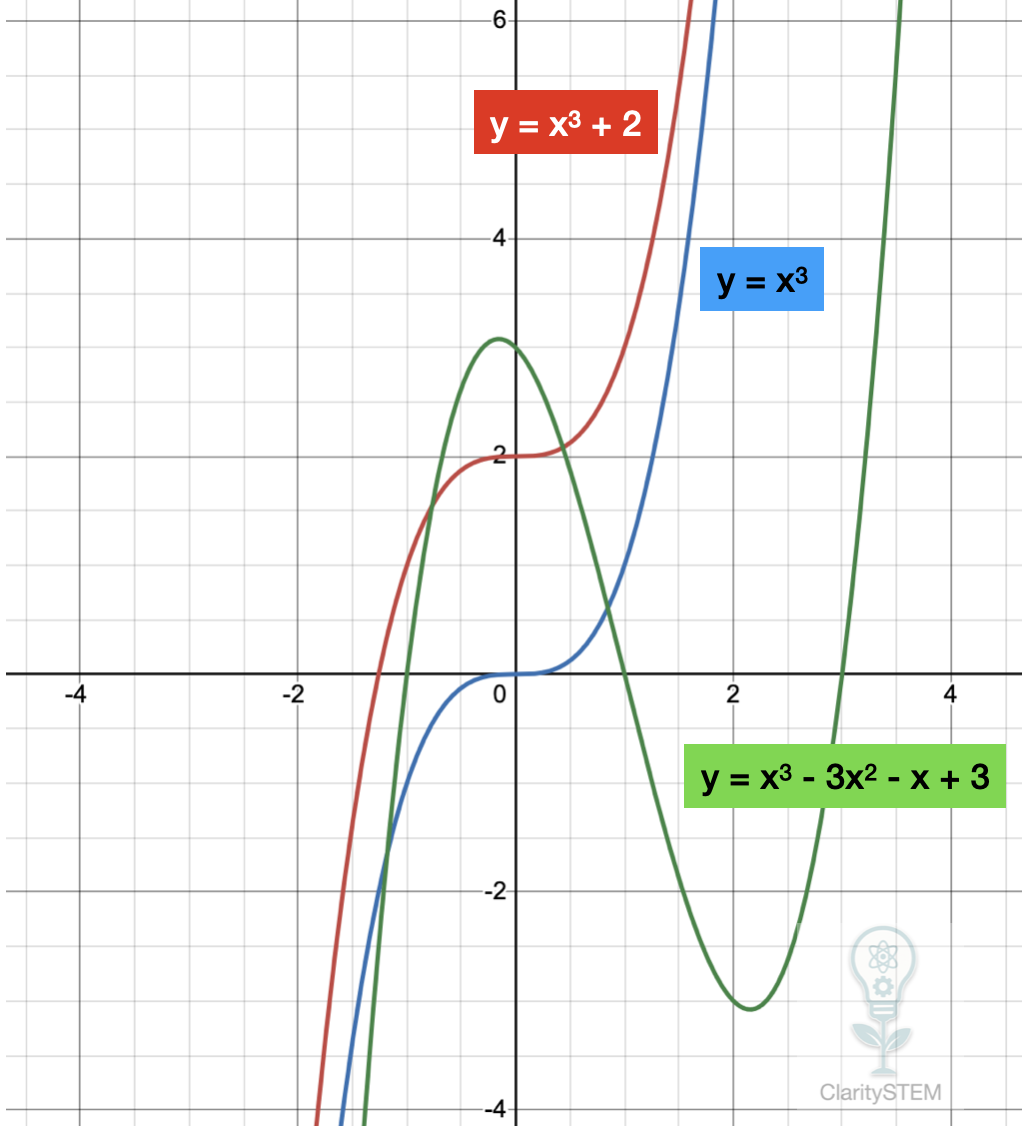
The graph does not have a maximum or minimum turning point, but it has a point of inflection where the curvature changes.
Example
$$
y = x^3 + 2
$$
This graph has the same shape as \( y = x^3 \) but is shifted up by 2 units.
Cubic Graphs of the Form y = ax³ + bx² + cx + d
This is the general form of a cubic graph.
The equation is written as
\( y = ax^3 + bx^2 + cx + d \)
These graphs are more complex and may change direction more than once.
The value of a still controls the overall direction of the graph.
a positive value of a means the graph rises to the right
a negative value of a means the graph falls to the right
The value of d gives the y intercept.
Graphs of this form may have one or two turning points and can cross the x axis up to three times.
Example
$$
y = x^3 - 3x^2 - x + 3
$$
To sketch this graph, you would usually find the y intercept and then calculate several points by substituting values of \( x \).
Interpreting Cubic Graphs
When interpreting cubic graphs, focus on their overall shape and key features.
Look at the direction of the graph as \( x \) becomes very large or very small.
Identify where the graph crosses the axes.
Notice any turning points or changes in curvature.
These features help you understand how the equation affects the graph.
Key Points to Remember
Cubic graphs have smooth curves and extend infinitely in both directions.
The sign of a controls the overall direction of the graph.
The constant term gives the y intercept.
Simple cubics are shifts of \( y = x^3 \).
More complex cubics can have turning points and multiple x intercepts.
Understanding the form of a cubic equation allows you to sketch and interpret its graph accurately and with confidence.