
Using the Form y = mx + c
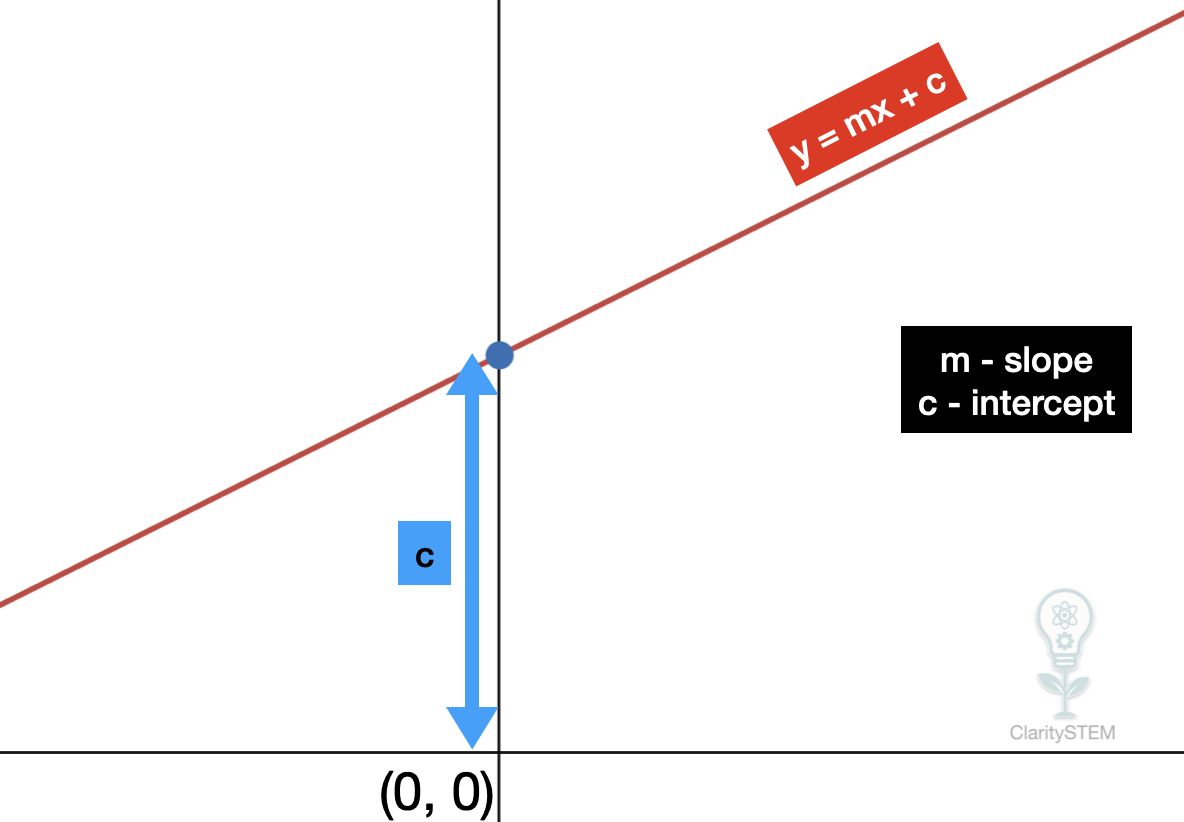
The equation of a straight line is often written in the form:
$$
y = mx + c
$$
This form makes it easy to understand and draw the graph of a straight line because each part of the equation has a clear meaning.
Understanding the Gradient m
The gradient, \( m \), tells you how steep the line is and the direction it slopes.
• If \( m \) is positive, the line slopes upwards from left to right
• If \( m \) is negative, the line slopes downwards from left to right
• If \( m \) is larger, the line is steeper
The gradient represents the change in \( y \) for a change of 1 in \( x \).
For example, in the equation:
$$
y = 2x + 1
$$
The gradient is \( 2 \). This means that for every increase of 1 in \( x \), \( y \) increases by 2.
Understanding the y-intercept c
The y-intercept, \( c \), is the value of \( y \) when \( x = 0 \).
It shows where the line crosses the y axis.
For example, in:
$$
y = 2x + 1
$$
When \( x = 0 \):
$$
y = 1
$$
So the line crosses the y axis at:
$$
(0,\ 1)
$$
If \( c \) is negative, the line crosses the y axis below the origin.
Drawing a Straight Line Using y = mx + c
To draw a straight line using the equation \( y = mx + c \):
- Plot the y-intercept \( (0,\ c) \)
- Use the gradient \( m \) to find another point
- Draw a straight line through the points
For example, for:
$$
y = -3x + 4
$$
The y-intercept is \( (0,\ 4) \).
The gradient is \( -3 \), so moving 1 unit to the right means moving 3 units down.
Another point is \( (1,\ 1) \).
Recognising the Gradient and Intercept from an Equation
Given a straight line equation in the form \( y = mx + c \):
• The number multiplying \( x \) is the gradient \( m \)
• The constant number is the y-intercept \( c \)
For example:
$$
y = 5x - 2
$$
Here:
• \( m = 5 \)
• \( c = -2 \)
Using y = mx + c to Interpret Graphs
If a graph is given, the gradient can be found by measuring how much \( y \) changes when \( x \) increases by 1.
The y-intercept is read directly from where the line crosses the y axis.
Matching a graph to its equation relies on identifying these two features correctly.
Key Points to Remember
The equation of a straight line is \( y = mx + c \).
\( m \) is the gradient and shows the steepness of the line.
\( c \) is the y-intercept and shows where the line crosses the y axis.
Plot the intercept first, then use the gradient to draw the line.
Being confident with the form \( y = mx + c \) is essential for graph work, coordinate geometry and solving problems involving straight lines.