
Interpreting Nets of 3-D Shapes
A net is a two dimensional pattern that can be folded to make a three dimensional shape. Being able to interpret nets helps you visualise how faces join together to form solid objects.
What a Net Is
A net shows all the faces of a 3-D shape laid flat.
Each face in the net corresponds to one face on the solid shape.
When the net is folded:
• faces meet along edges
• edges line up exactly
• vertices come together correctly
If the faces do not join properly, the net will not form the shape.
Interpreting Nets of Common 3-D Shapes
Different 3-D shapes have characteristic nets.
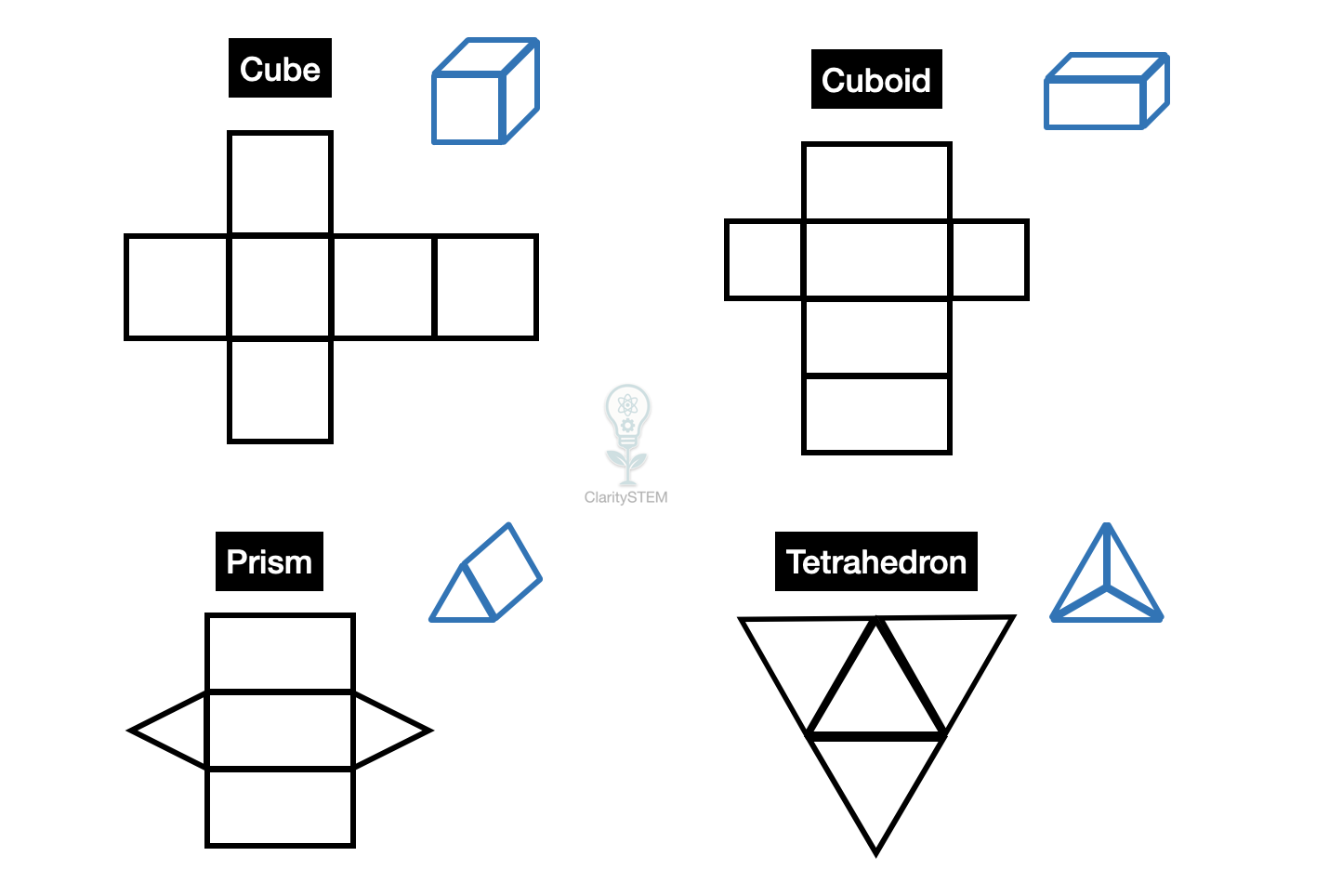
A cube net consists of six equal squares arranged so that four form a strip, with one square attached above and one below.
A cuboid net has six rectangles, with opposite faces equal in size.
A triangular prism net has:
• two triangular faces
• three rectangular faces joining them
A square based pyramid net has:
• one square base
• four triangular faces attached to each side of the square
A cylinder net consists of:
• one rectangle representing the curved surface
• two identical circles representing the flat faces
A cone net consists of:
• one circular sector
• one circular base
A sphere does not have a net because it has no flat faces.
Matching Nets to Shapes
To interpret a net, imagine folding it in your mind.
Check:
• the number of faces
• the shape of each face
• which faces are adjacent
• whether faces would overlap when folded
Faces that share an edge in the net will share an edge on the 3-D shape.
The orientation of faces is just as important as their shape
Common Tasks Involving Nets
You may be asked to:
• identify which net matches a given 3-D shape
• decide whether a net will fold to make a solid
• label faces, edges or vertices on a net
• draw a net for a given 3-D shape
Careful visualisation is key in each case.
Common Errors to Avoid
Common mistakes include:
• assuming any arrangement of faces will work
• forgetting that faces must not overlap
• miscounting faces
• ignoring the shape of the faces
Always check that every face of the 3-D shape is represented once in the net.
Key Points to Remember
A net is a flat pattern that folds to form a 3-D shape.
Each face in the net becomes a face of the solid.
Not all arrangements of faces will form a valid net.
Some shapes have many possible nets.
Visualising the folding process helps avoid errors.
Interpreting nets of 3-D shapes develops spatial awareness and helps connect two dimensional drawings with three dimensional objects.