
Angle Properties of Triangles and Quadrilaterals
Certain shapes have fixed angle properties that can be recalled and used to find unknown angles. These rules apply every time and form the basis of many geometry problems.
Angle Properties of Triangles
All triangles have interior angles that add up to
\( 180^\circ \)
Different types of triangles also have specific angle properties.
A right angled triangle has one angle equal to
\( 90^\circ \)
The other two angles must add up to
\( 90^\circ \)
An isosceles triangle has two equal sides.
The angles opposite the equal sides are also equal.
If one of these angles is known, the other can be found immediately.
An equilateral triangle has all sides equal.
All interior angles in an equilateral triangle are equal to
\( 60^\circ \)
Exterior Angle of a Triangle
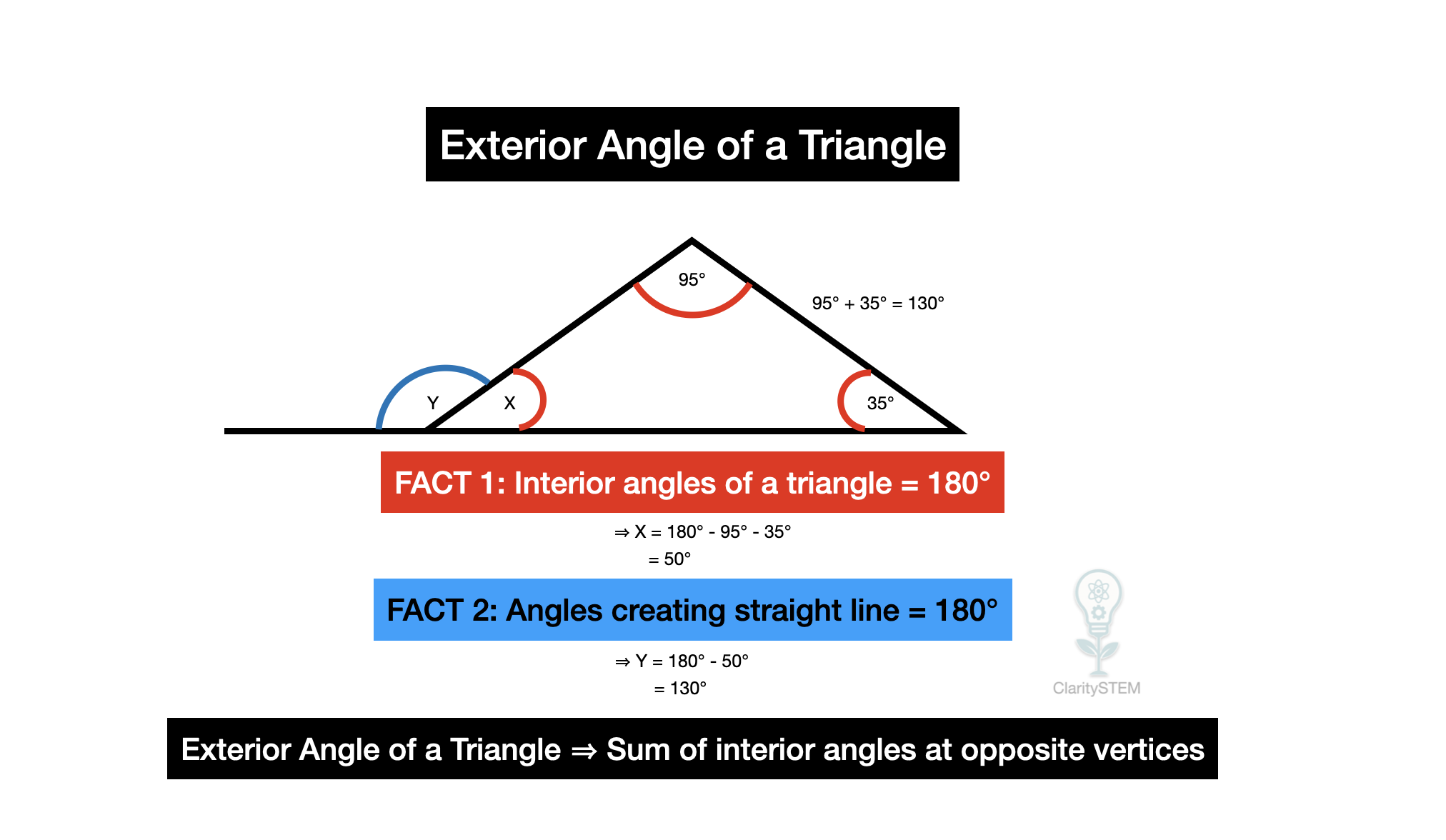
An exterior angle is formed when one side of a triangle is extended.
The exterior angle of a triangle is equal to the sum of the two interior angles at the other vertices.
This can be written as:
\( exterior\ angle = interior\ angle_1 + interior\ angle_2 \)
This rule is useful when angles inside the triangle are difficult to find directly.
Sum of Angles in a Quadrilateral
A quadrilateral is a shape with four sides.
The interior angles of any quadrilateral add up to
\( 360^\circ \)
This applies to all quadrilaterals, regardless of their shape.
If three interior angles are known, the fourth can be found by subtracting their sum from
\( 360^\circ \)
Angle Properties of Special Quadrilaterals
Some quadrilaterals have additional angle properties.
A rectangle has:
• four right angles
• opposite angles equal
Each interior angle is
\( 90^\circ \)
A parallelogram has:
• opposite angles equal
• adjacent angles that add up to
\( 180^\circ \)
A kite has:
• one pair of equal opposite angles
• angles between the unequal sides equal
The symmetry of the shape helps identify which angles are equal.
Always identify the type of quadrilateral before applying angle rules
Key Points to Remember
Right angled triangles contain a \( 90^\circ \) angle.
Isosceles triangles have two equal angles.
Equilateral triangles have three angles of \( 60^\circ \).
The exterior angle of a triangle equals the sum of the two opposite interior angles.
The angles in a quadrilateral add up to \( 360^\circ \).
Special quadrilaterals have additional angle properties that can be used to find unknown angles.
Recalling and applying these angle properties allows complex geometric problems to be solved clearly and accurately.