
Circle Theorems
⭐ Higher Tier Content
Circle theorems are rules about angles, lines and shapes formed inside and around circles. These theorems are used to find unknown angles and lengths and to justify geometric reasoning clearly.
Tangent and Radius
The tangent at any point on a circle is perpendicular to the radius at that point.
This means the angle between a tangent and the radius at the point of contact is
\( 90^\circ \)
This property is often used to identify right angles in circle diagrams.
Angle at the Centre and Circumference
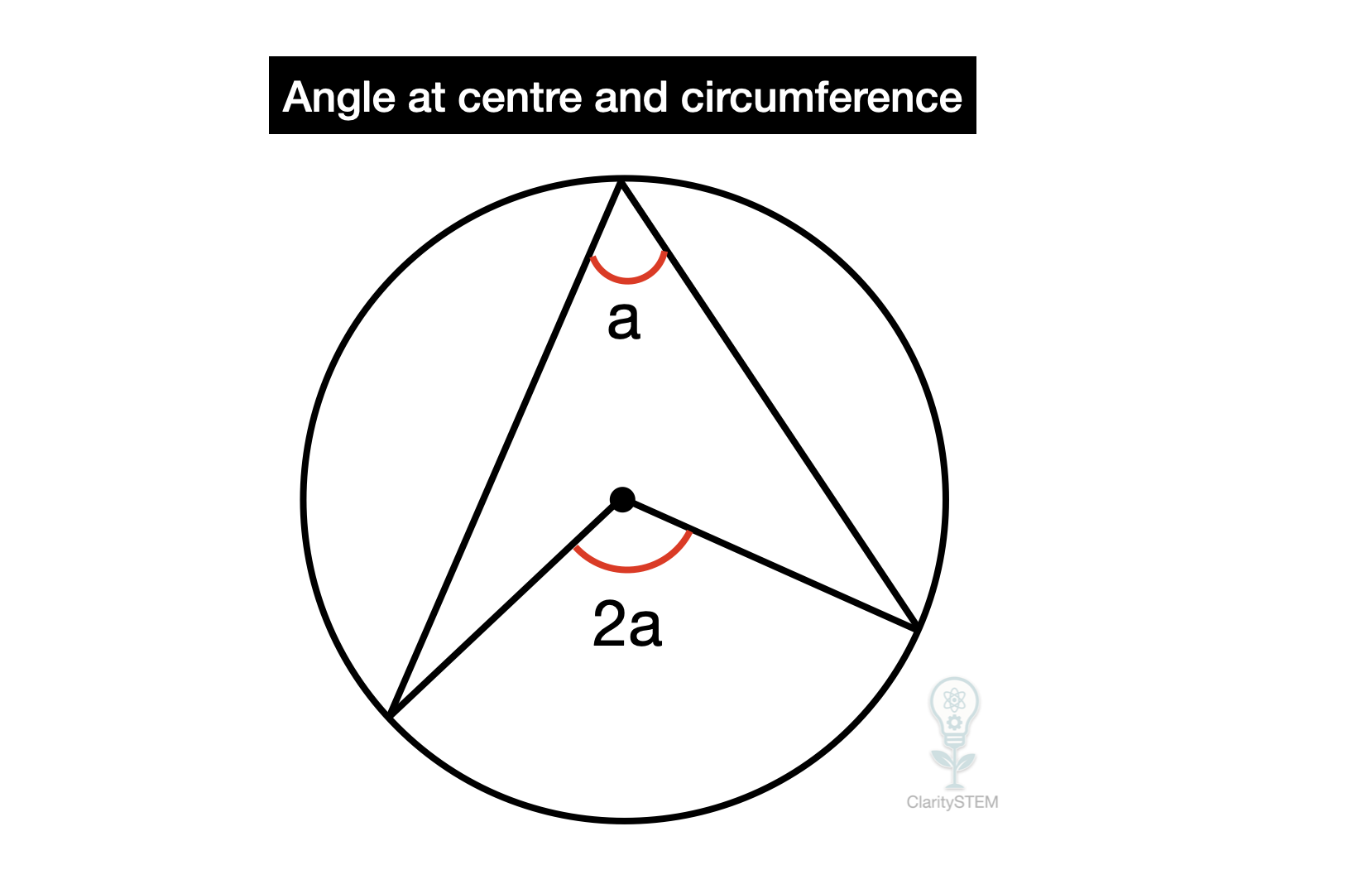
The angle subtended by an arc at the centre of a circle is twice the angle subtended by the same arc at the circumference.
If the angle at the circumference is
\( x \)
then the angle at the centre is
\( 2x \)
Both angles must stand on the same arc.
Angle in a Semicircle
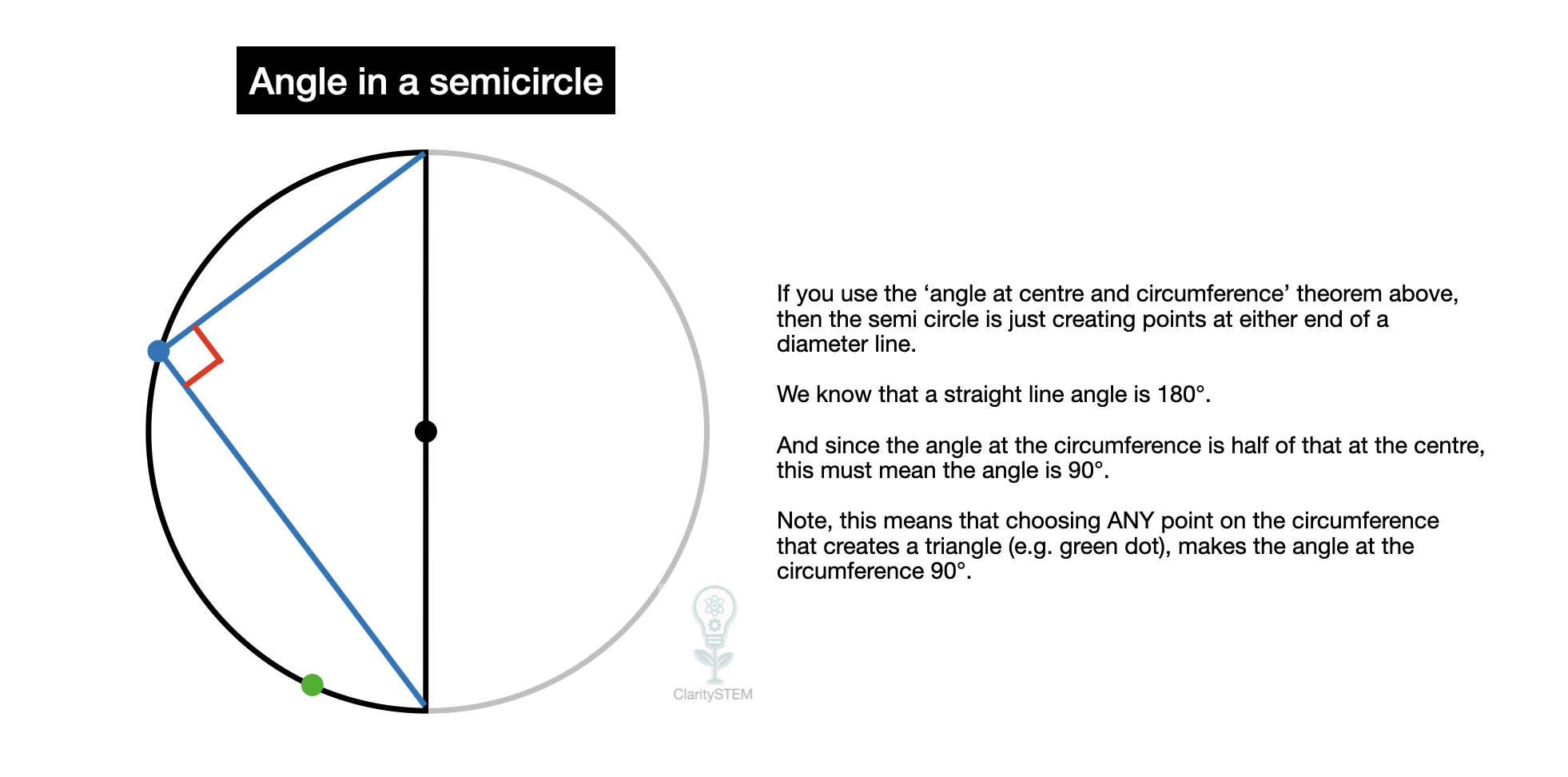
The angle subtended at the circumference by a semicircle is a right angle.
This means any angle formed at the circumference by a diameter is
\( 90^\circ \)
This rule applies regardless of where the point lies on the circle.
Angles in the Same Segment
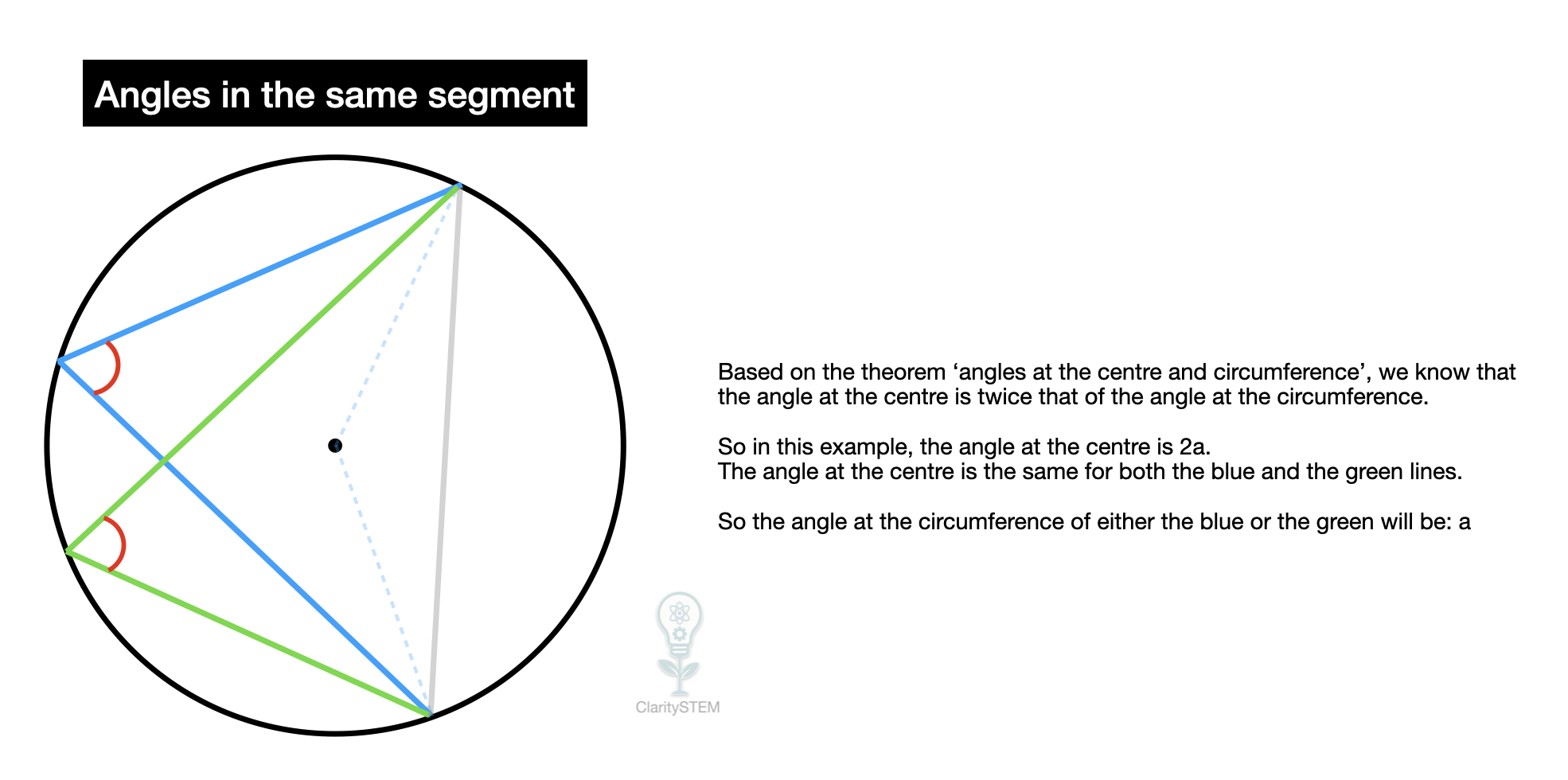
Angles in the same segment of a circle are equal.
This means that angles subtended by the same chord, at the circumference and on the same side of the chord, have the same size.
This theorem is useful for identifying equal angles without calculation.
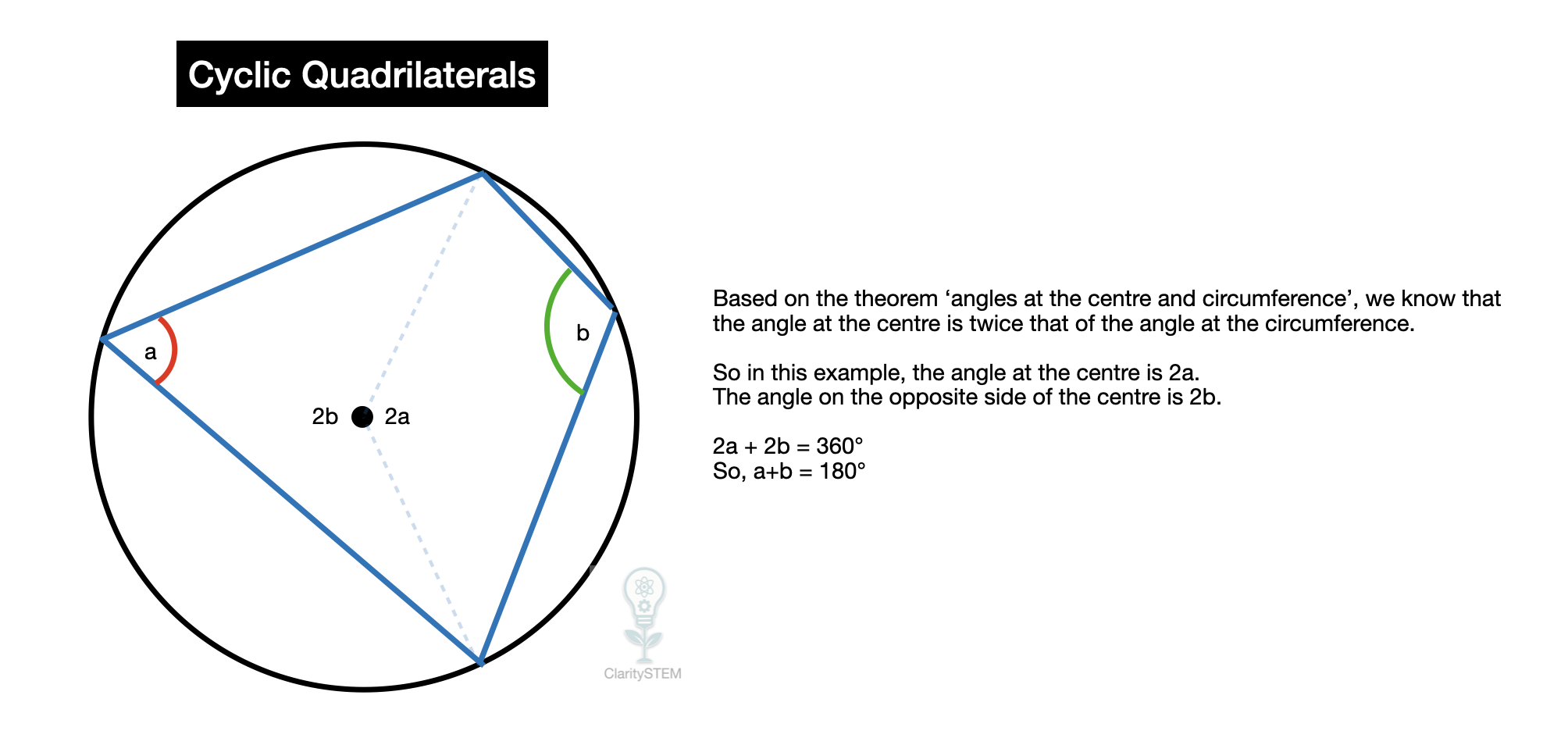
For angles drawn on the opposite side of the chord, they are supplementary angles so they can be calculated as
\( 180^\circ - x^\circ \)
This is because an angle on one side of the chord (at the circumference), \( x \), is half that at the circle, \( 2x \). The angle on the other side of the chord (at the circumference), \( y \), is also half that at the circle, \( 2y \).
But both angles at the centre, make a full turn, so:
\( 2x + 2y = 360^\circ \)
And therefore, \( (x + y) = 180^\circ \)
So,
\( 180^\circ - x^\circ = y^\circ \)
Cyclic Quadrilaterals
A cyclic quadrilateral is a four sided shape where all vertices lie on a circle.
The opposite angles of a cyclic quadrilateral add up to
\( 180^\circ \)
If one angle is known, the opposite angle can be found by subtracting from
\( 180^\circ \)
Alternate Segment Theorem
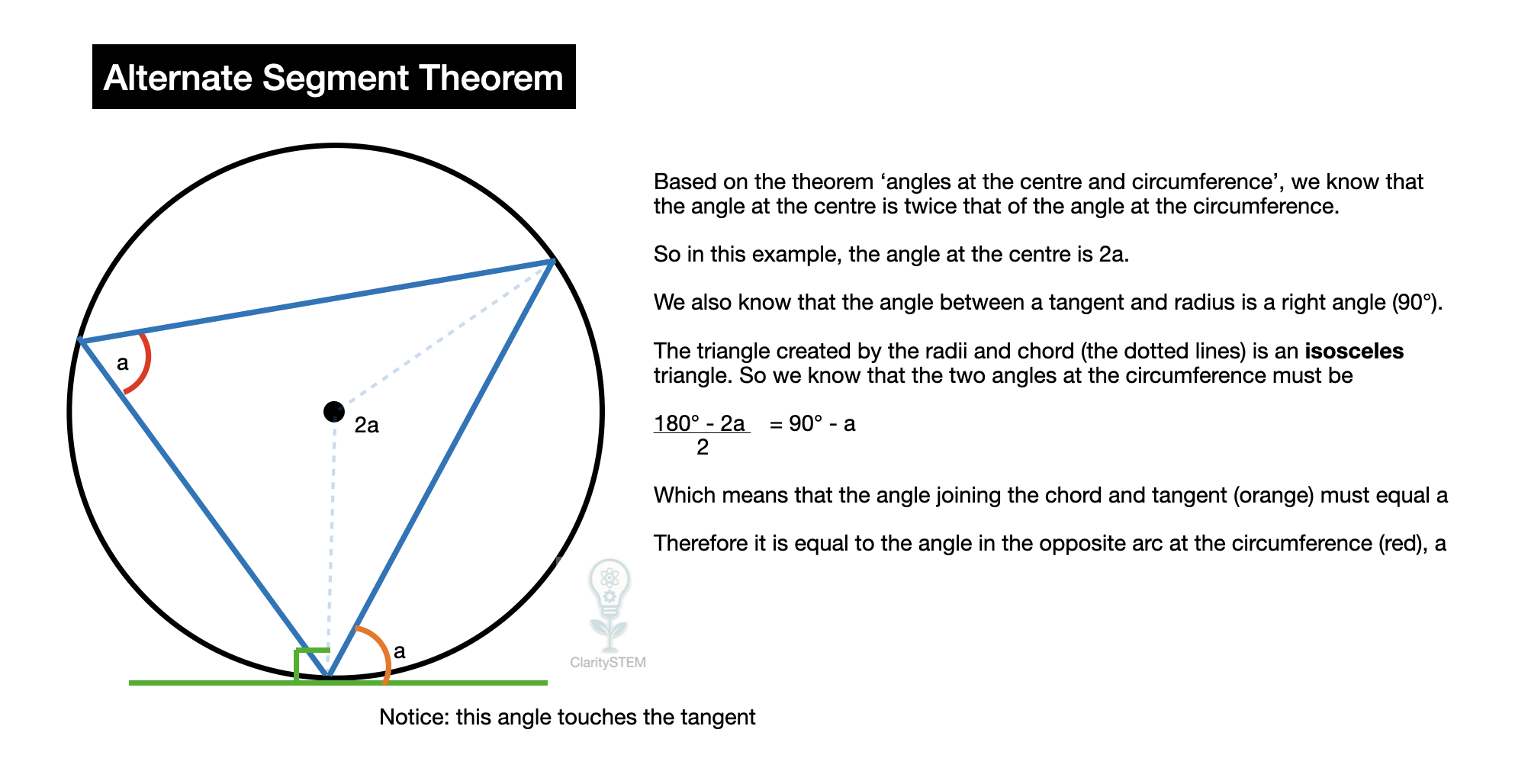
The alternate segment theorem links tangents and angles in the circle.
The angle between a tangent and a chord through the point of contact is equal to the angle in the opposite arc at the circumference.
This allows angles involving tangents to be related to angles inside the circle.
Tangents from an External Point
Tangents drawn from the same external point to a circle are equal in length.
If two tangents touch the circle from the same point outside the circle, their lengths are the same.
This is because the 2 triangles (one for each tangent) created from:
- The centre of the circle
- The point outside the circle
- The point at which the tangent touches the circle
Will be congruent due to the RHS rule, which means that the length of the line between the point outside the circle, to each of the points where the tangent touches the circle are identical.
This property is often used in problems involving lengths rather than angles.
Key Points to Remember
A tangent is perpendicular to the radius at the point of contact.
The angle at the centre is twice the angle at the circumference on the same arc.
The angle in a semicircle is a right angle.
Angles in the same segment are equal.
Opposite angles in a cyclic quadrilateral add up to \( 180^\circ \).
Tangents from the same external point are equal in length.
Circle theorems provide powerful geometric relationships that allow angles and lengths in circle diagrams to be found accurately and justified clearly.