
Using Pythagoras’ Theorem in 3-D
⭐ Higher Tier Content
Pythagoras’ theorem can be extended to three dimensional shapes to find unknown lengths such as space diagonals. It is also used in reverse problems to check whether angles are right angles in 3-D contexts.
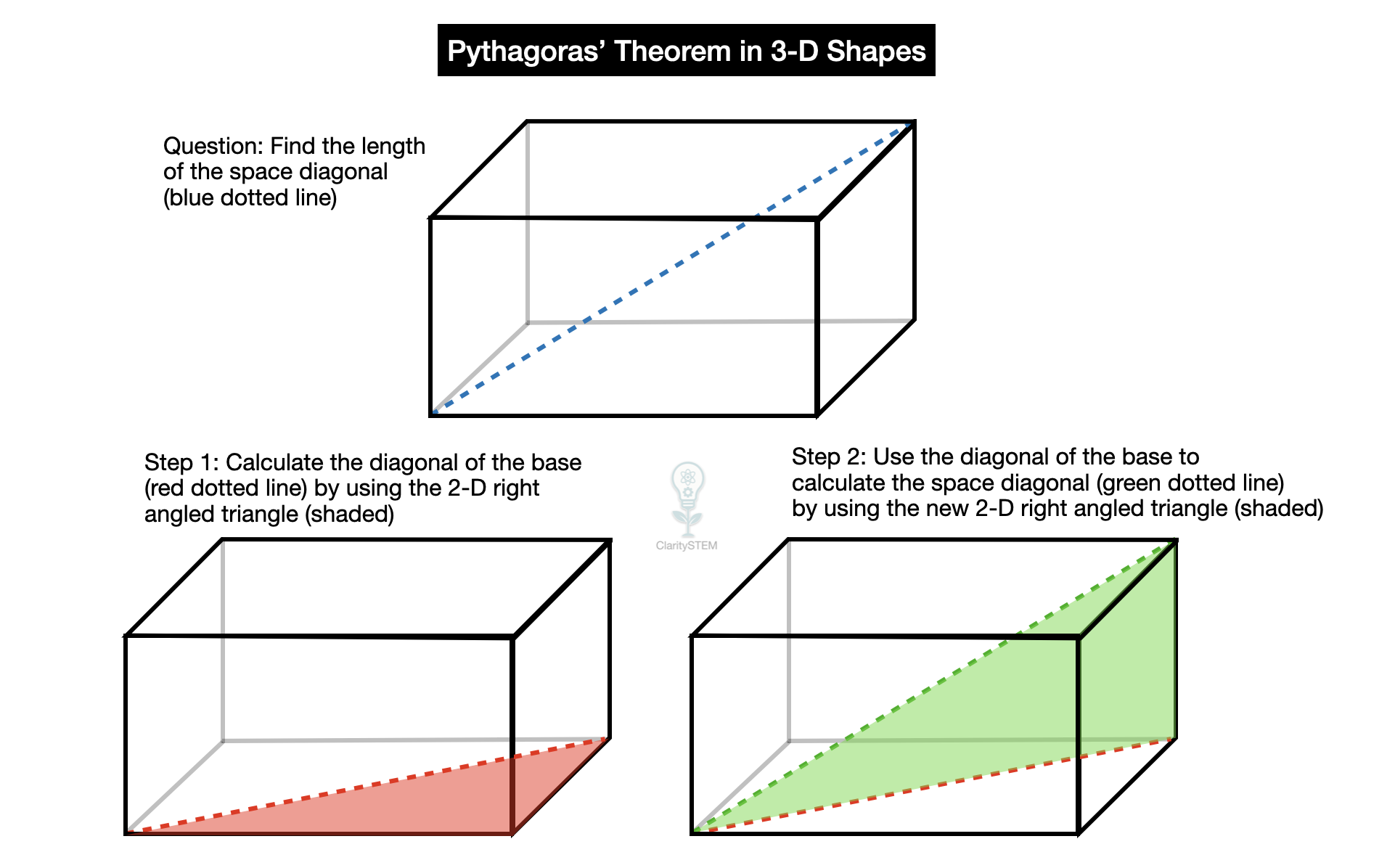
Using Pythagoras’ Theorem in 3-D Shapes
In three dimensions, Pythagoras’ theorem is applied in stages.
A right angled triangle must always be identified first, even if it lies inside a 3-D shape.
Common situations include:
• finding the diagonal of a rectangular face
• finding the space diagonal of a cuboid
• finding distances between opposite vertices
The theorem used is still:
$$
a^2 + b^2 = c^2
$$
Finding a Space Diagonal of a Cuboid
A space diagonal joins two opposite vertices of a cuboid.
To find it:
• first find the diagonal of the base
• then use Pythagoras’ theorem again with the height
Example
A cuboid has length 4 cm, width 3 cm and height 12 cm.
Step 1: Find the diagonal of the base
$$
4^2 + 3^2 = d^2
$$
$$
16 + 9 = d^2
$$
$$
d^2 = 25
$$
$$
d = 5
$$
Step 2: Use the height to find the space diagonal
$$
5^2 + 12^2 = x^2
$$
$$
25 + 144 = x^2
$$
$$
x^2 = 169
$$
$$
x = 13
$$
The space diagonal is 13 cm.
Using Pythagoras’ Theorem in Other 3-D Contexts
Pythagoras’ theorem can also be used in:
• pyramids to find sloping edges
• triangular prisms to find face diagonals
• composite solids by splitting them into simpler shapes
Always identify a right angled triangle before applying the theorem.
Visualising the triangle correctly is essential
Reverse Pythagoras’ Theorem in 3-D
Reverse Pythagoras’ theorem is used to check whether an angle in a 3-D shape is a right angle.
To do this:
• identify three connected edges
• square the two shorter lengths
• compare their sum to the square of the longest length
If:
$$
a^2 + b^2 = c^2
$$
then the angle between sides \( a \) and \( b \) is a right angle.
Example
Three edges meeting at a point have lengths 6 cm, 8 cm and 10 cm.
$$
6^2 + 8^2 = 36 + 64 = 100
$$
$$
10^2 = 100
$$
Since the values match, the angle between the shorter edges is a right angle.
Important Conditions
Pythagoras’ theorem:
• only applies to right angled triangles
• may need to be applied more than once in 3-D
• requires correct identification of the triangle used
Choosing the wrong triangle leads to incorrect answers
Key Points to Remember
Pythagoras’ theorem can be used in three dimensions by working step by step.
A right angled triangle must always be identified first.
Space diagonals are found using two applications of the theorem.
Reverse Pythagoras’ theorem checks for right angles in 3-D.
Clear diagrams help identify correct triangles.
Using Pythagoras’ theorem confidently in 3-D allows complex distances and angles within solid shapes to be calculated and verified accurately.